Concreting
Shed and Garage Slabs Hemmant.
Reinforced Concrete Slabs for Sheds and Garages in Hemmant
A solid slab under a shed or garage isn't just a nice-to-have. It protects your tools and vehicles from moisture, gives you a level working surface, and means the structure above it will stay square for decades. In Hemmant and across the Bayside cluster, the combination of clay-heavy soils, seasonal flooding risk, and salt-laden air makes the quality of that slab more important than it might be in drier, inland Brisbane suburbs.
This page covers what the work actually involves, what you should expect to pay, and how to tell whether this is the right job for your property right now.
What the Work Involves
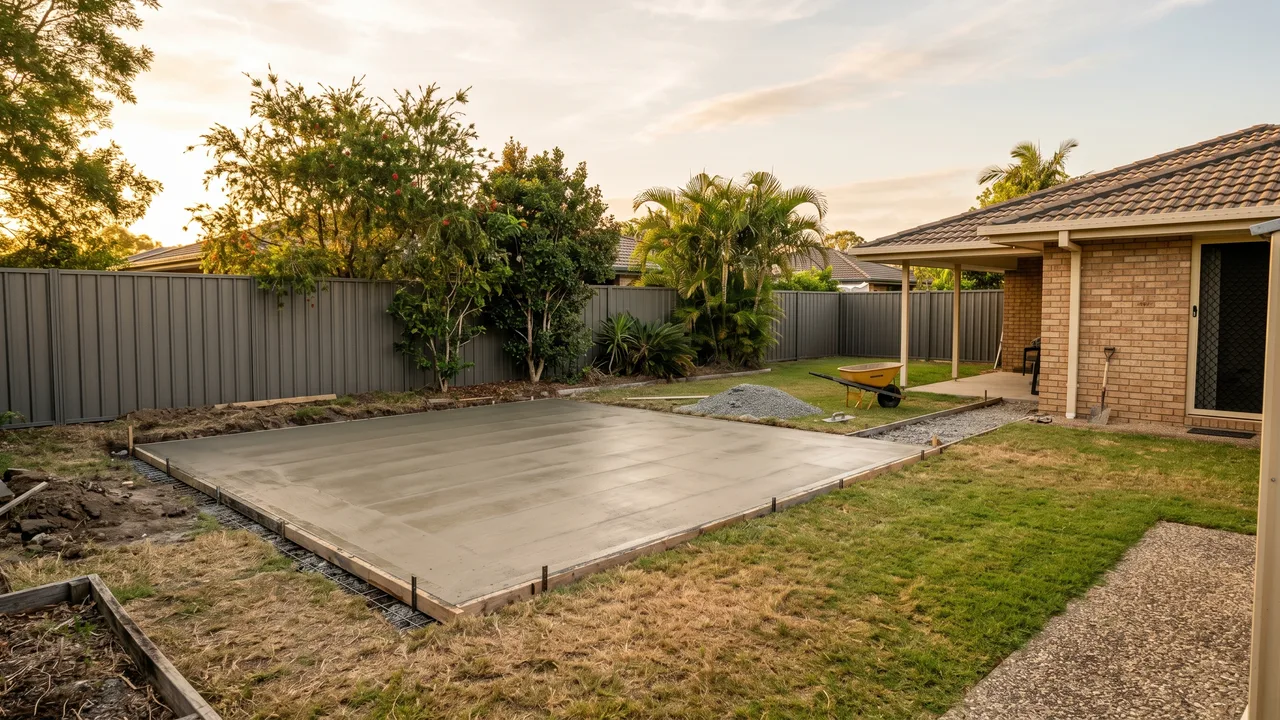
A shed or garage slab is a reinforced concrete pour, typically 85 to 100 mm thick for a standard residential shed and 100 to 125 mm for a garage intended to take vehicle loads. Here is what the process looks like on the ground:
- Site preparation. The area is pegged and levelled. Topsoil, grass and loose fill are excavated, usually to around 150 mm depth to allow for compacted sub-base and the slab itself.
- Sub-base compaction. A layer of road base or crusher dust is laid and mechanically compacted. This is the step that most separates a professional pour from a rushed job. On Hemmant's clay-rich ground, skipping this step is where slabs crack.
- Formwork. Timber or steel forms are set to hold the concrete in shape and to control the finished edge profile.
- Steel reinforcement. SL72 or SL82 mesh (or, for heavier loads, deformed bar) is laid on bar chairs so it sits in the middle third of the slab, not on the ground. In Bayside areas with higher moisture exposure, the concrete cover over the steel matters for long-term durability.
- Concrete pour. Ready-mix concrete is ordered to a specified strength, typically N20 or N25 for residential applications. The truck chutes it into the forms, and the crew screeds, floats and finishes the surface.
- Curing. The slab is kept moist or covered for at least three days, ideally seven, to reach working strength. Rushing curing is another common cause of surface cracking.
The whole process, from prep to pour, is typically done in one to two days for a standard residential slab. The concrete then needs around 28 days to reach full design strength, though it is usually walkable within 24 to 48 hours and ready for light vehicle traffic in about a week.
When Do You Actually Need One?
You need a new shed or garage slab when you are building a new outbuilding from scratch, or when an existing slab has deteriorated to the point where repairs cost more than replacement.
Signs an existing slab is past repair include: multiple intersecting cracks wider than about 5 mm, sections that rock underfoot, significant ponding after rain (meaning the slab has settled unevenly), or heaving caused by root intrusion or sub-base movement. In Hemmant specifically, homes with older timber or hardstand floors under corrugated iron sheds are often good candidates for a first-time concrete slab when the owner wants to convert to a proper lockup garage.
There is no strict season for this work, but most concreters prefer to pour in the cooler months (May through August) when temperatures sit in the low-to-mid twenties. Summer pours in South East Queensland can be done but require more careful curing management because the heat accelerates the set.
What It Typically Costs
For a residential shed or garage slab in the Hemmant area, typical pricing runs from around $60 to $100 per square metre for a standard reinforced slab, finished broom or smooth.
As a rough guide:
- A 3 x 6 m garden shed slab (18 m²): approximately $1,100 to $1,800
- A single-car garage slab (around 30 m²): approximately $1,800 to $3,000
- A double-car garage slab (around 55 to 60 m²): approximately $3,300 to $6,000
These figures are indicative. What moves the price:
- Access. If the truck cannot get close, concrete needs to be barrowed or pumped. Pump hire adds $500 to $900 in most cases.
- Excavation depth. Significant cut-and-fill on a sloped block, common in parts of Wynnum and Lota, adds earthwork costs.
- Soil conditions. Some Bayside blocks have fill or reactive clay that requires a thicker slab or additional reinforcement.
- Footings. If the shed manufacturer or a structural engineer specifies strip footings or pier footings around the perimeter, that is an additional scope item.
- Finish. A broom finish is standard and included. Smooth steel trowel or any decorative finish costs more.
What Is Usually Included and What Is Not
A typical quote for this service includes: site visit and measure-up, formwork, sub-base preparation, reinforcement mesh, the concrete pour, basic broom finish, and site clean-up.
What is often quoted separately or excluded: council permits if required, any drainage works, removal of an existing slab, concrete saw-cutting for control joints (sometimes included, worth confirming), and pump hire if access is restricted.
Ask the contractor to confirm in writing whether those items are included before you accept a quote.
Is This the Right Service for Your Property?
If you are building or replacing a free-standing outbuilding with a floor area under roughly 100 m², you are almost certainly looking at a standard shed and garage slab. If the structure is attached to the main dwelling, shares a wall, or exceeds that size, it may need engineer input or a building permit, and the concreting scope might be more complex.
For decorative options (like an exposed aggregate garage floor), that is a separate service with different pricing. For pathways leading from the slab to the house or street, that would be scoped as a separate patio or pathway job.
A Note on Safety and Qualifications
Concrete work does not require a specific concreting licence in Queensland, but any earthworks affecting the structural integrity of neighbouring properties or existing drainage can have legal implications. For jobs that involve significant excavation or are close to a property boundary, it is worth confirming your contractor carries public liability insurance. The contractors we refer through this service carry current public liability cover, and we are happy to confirm that before connecting you.
If your block is in Hemmant, Wynnum, Manly, Lota, Wynnum West or Manly West, and you have a shed or garage project that needs a concrete floor, a quick call is the easiest way to get a site-specific estimate rather than guessing from square-metre rates.
Quick answers
Frequently asked.
How thick should a shed or garage slab be in Hemmant?
Do I need a council permit for a concrete slab in Hemmant?
Can a concrete slab be poured in summer in South East Queensland?
What is the difference between mesh reinforcement and rebar for a garage slab?
Will the slab need control joints cut into it?
How long before I can park a car on a new garage slab?
Ready to book
Quickest is by phone.
Up-front pricing on the call. Booked in one go. No site visit needed.