Concreting
Shed and Garage Slabs Hemmant.
Shed and Garage Slabs in Hemmant
A solid concrete slab is the foundation everything else depends on. Get it wrong and you're looking at cracked floors, uneven walls, and doors that won't close properly. Get it right and it will outlast the shed or garage sitting on it by decades.
Here's what the work actually involves, what it costs around Bayside Brisbane, and how to know whether this is the job you need.
What the Work Involves
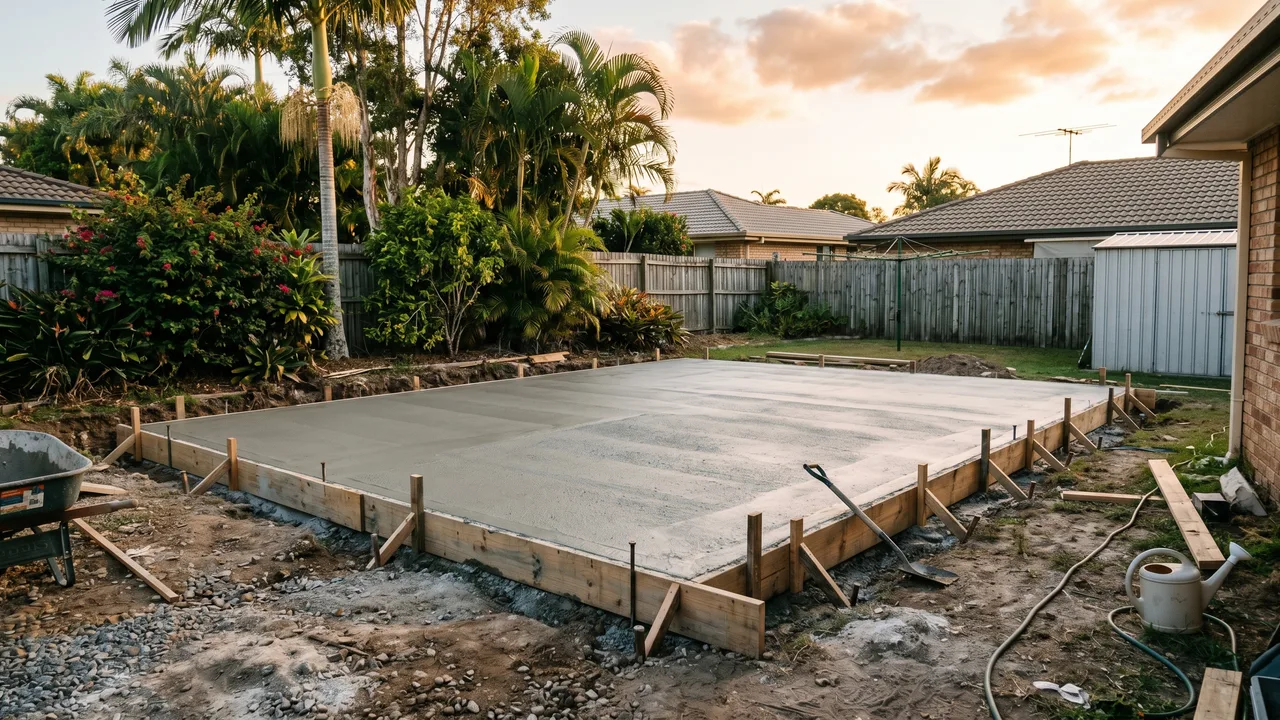
Pouring a shed or garage slab is a multi-step job, not a one-day affair. A concrete crew working in Hemmant and nearby suburbs like Wynnum, Manly, and Lota will typically:
- Mark out and excavate the slab footprint, usually removing 100-150 mm of soil and subbase material
- Set up formwork (timber or steel edging) to hold the wet concrete in shape
- Compact the subgrade with a plate compactor so the slab has a stable base
- Lay a vapour barrier (polythene sheeting) to reduce moisture migration from the ground
- Place steel reinforcement, typically F72 or F82 mesh, or deformed bar (reo bar) for heavier loads such as a vehicle workshop
- Pour and screed the concrete to a consistent level
- Finish the surface - a broom finish is standard for garages and sheds; a smooth trowel finish is sometimes requested for workshops
- Cut control joints after the pour to manage where any future cracking occurs
Ready-mix concrete delivered by a truck is standard for anything above about 8-10 square metres. Smaller infill areas might be bagged mix, but a full slab almost always comes off a mixer truck.
Curing time matters here. The slab needs at least 7 days before light foot traffic and typically 28 days before you drive a vehicle onto it.
When Do You Actually Need One?
Most Hemmant homeowners reach this point for one of a few reasons:
- You're putting up a new shed, Colorbond garage, or carport and need the slab poured before the steel frame arrives
- Your existing slab is cracked badly enough that resurfacing won't fix it (if it's mainly cosmetic wear, concrete resurfacing may be enough)
- You're converting an underhouse area or carport into an enclosed garage and need a proper structural slab
- You're building a pool equipment shed, workshop, or home gym and need a level, load-bearing base
There's no seasonal "best time" to pour concrete in Brisbane, but extremely hot days (above 35°C) can accelerate the set and make finishing harder. Summer afternoon thunderstorms are also a real hazard around Bayside. Most local crews plan morning pours to stay ahead of the heat and any afternoon weather.
What It Typically Costs Around Hemmant
Shed and garage slabs in the Bayside area generally run between $80 and $130 per square metre, all up. That puts a standard 6 x 6 m double garage slab (36 sqm) somewhere in the $2,900 to $4,700 range, depending on conditions.
What pushes the price up:
- Difficult access - narrow side gates in older Hemmant and Wynnum homes mean concrete may need to be wheelbarrowed in, which adds labour
- Soft or unstable subsoil - some bayside blocks sit on fill or reactive clay that needs deeper excavation or extra compaction
- Thicker slabs - a standard domestic slab is 100 mm; a heavy workshop slab might call for 150 mm with deformed bar instead of mesh
- Extra reinforcement for a slab supporting a car hoist or heavy machinery
- Sloped sites that require cut-and-fill earthworks before formwork can even go in
What's usually included in a quote: excavation to standard depth, formwork, mesh reinforcement, concrete supply and pour, basic finish, and control joint cuts.
What's often extra or quoted separately: soil removal and tip fees, tree root clearing (common in Manly and Wynnum with large fig and jacaranda roots), retaining if the site is sloped, and any council permits.
Always ask the contractor to itemise these before you accept a quote.
Is This the Right Service for Your Situation?
A full new slab is the right call when you're building from scratch or when an existing slab has structural cracks (cracks that are wide, displaced, or growing). If the concrete is sound but just tired-looking, resurfacing is a better spend.
If you're unsure, a quick site visit from a concreter will usually clear it up. Describe what you see: wide cracks with one side sitting higher than the other suggest foundation movement, not just surface wear.
A Note on Safety and Licensing
Concrete work in Queensland doesn't require a builder's licence for standard domestic slabs, but it does require genuine trade experience and, importantly, public liability insurance. Before any crew starts work on your property, ask to see their current insurance certificate. Any legitimate operator will hand it over without hesitation. This service connects you with local providers who carry appropriate cover.
If you want a straight answer on what your slab will cost before you commit to anything, get in touch with the details of your site and we'll put you in contact with a Hemmant-area concreter who can give you a proper number.
Quick answers
Frequently asked.
How thick should a garage slab be in Hemmant?
Do I need a council permit for a shed slab in Brisbane?
How long does a shed or garage slab take to complete?
Will bayside soil conditions in Hemmant affect my slab?
What is the difference between mesh reinforcement and reo bar for a slab?
Can a concrete slab be poured if there is a tree nearby?
Ready to book
Quickest is by phone.
Up-front pricing on the call. Booked in one go. No site visit needed.