Concreting
Pathways and Patios Hemmant.
Concrete Pathways and Patios for Hemmant Homes
A concrete pathway or patio is one of those jobs that looks simple from the street but involves a surprising amount of groundwork. Getting it right means years of use with minimal fuss. Getting it wrong means cracking, pooling water, and a surface that looks tired within a couple of Brisbane summers.
Here's what's actually involved, what it costs, and how to tell if your property needs it.
What the Work Involves
A pathway or patio pour starts well before the concrete truck arrives. The crew marks out the area, strips existing grass or soil to a suitable depth (typically 100mm for a pathway, 100-150mm for a patio slab), and grades the base to ensure water drains away from the house. In Hemmant and across the Bayside cluster, sandy or reactive soils are common, so the base preparation matters more than most people expect.
After compaction, the team lays formwork (the timber or steel boxing that holds the wet concrete in shape), places steel reinforcement mesh or bar, and pours the concrete mix. For residential patios, a standard 20-25 MPa mix is typical, though areas that will take vehicle loads or heavy outdoor kitchens may call for something stronger.
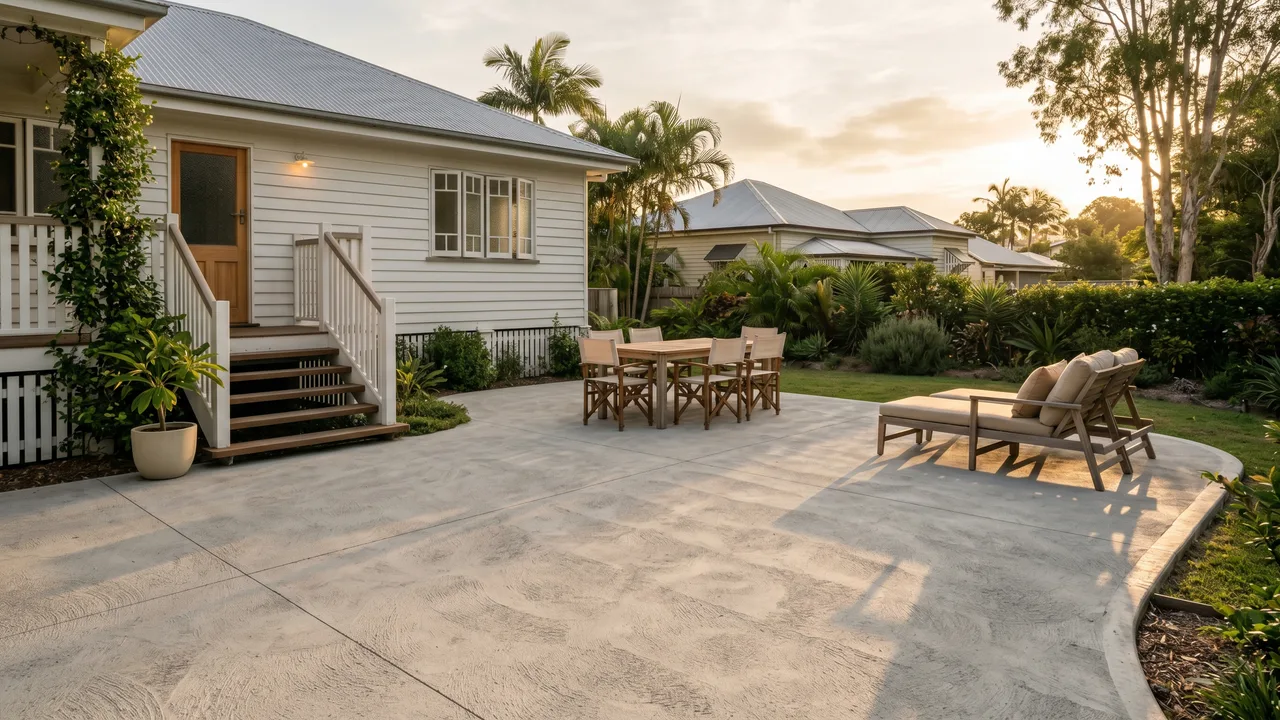
Finishing comes next: screeding, floating, and applying the surface texture. A broom finish is the most common choice for pathways because it gives grip in wet weather. Patios often get a smoother hand-float finish, or you might choose exposed aggregate if you want something more decorative (that's a separate process covered on its own page).
Control joints are cut or tooled in at regular intervals to give the concrete somewhere to move without cracking randomly. Finally, a curing compound is usually sprayed on to slow moisture loss, which is particularly important in Brisbane's warm, often breezy conditions.
When Hemmant Homeowners Typically Need This Work
- Existing concrete is cracking or lifting. Tree roots, soil movement and age all contribute. If the cracks are wider than about 3-4mm or the slab is rocking underfoot, patching is unlikely to be a long-term fix.
- You're building or extending an alfresco area. New pergolas and outdoor entertainment spaces almost always need a slab poured to finish them properly.
- Your garden paths are uneven or soft. Pavers shift and sink; replacing them with a formed concrete path is often the lower-maintenance choice over a 10-year horizon.
- You're preparing to sell. A crumbling front path or stained back patio affects how a property presents. Concrete work before listing is a common request in the Wynnum and Manly markets.
There's no fixed season for this work in Brisbane, but most concreters prefer to avoid pouring in extreme heat (above about 35°C) because the concrete sets too quickly to finish properly. Late autumn through spring is typically the busiest period.
What It Costs in the Hemmant Area
Typical pricing for residential pathways and patios in this part of Brisbane runs somewhere between $70 and $120 per square metre, all in. That range moves depending on:
- Size of the pour. Smaller jobs cost more per square metre because setup, delivery and labour costs don't scale down proportionally. A 10m² side path costs more per square metre than a 40m² alfresco slab.
- Access to the site. Narrow side gates, steep blocks, or a long carry from the truck to the pour area adds labour time and often cost.
- Soil conditions and prep required. If the base needs significant fill, compaction or rock breaking, that adds to the quote.
- Finish type. A standard broom finish is the baseline. Exposed aggregate, stencilled or coloured concrete each add cost.
For a typical backyard patio of 30-50m² in Hemmant or nearby Wynnum, a rough ballpark is $2,500 to $6,000, though this varies considerably. Treat any figure here as a starting point, not a quote.
What's Usually Included vs What May Cost Extra
Typically included in a quote:
- Excavation and base preparation to standard depth
- Formwork, mesh reinforcement and concrete supply
- Standard broom or float finish
- Control joint cutting
- Basic site clean-up
Often quoted separately or as extras:
- Disposal of excavated material (particularly if there's existing concrete to remove)
- Coloured oxide, exposed aggregate or decorative finishes
- Steps, edges or transitions to other surfaces
- Retaining edges on sloped sites
Always ask for a written, itemised quote before work starts. Good operators will be specific about what's in scope.
Is Concrete the Right Choice for Your Property?
Concrete suits Bayside homes well. It handles the salt air without corroding the way some metal or timber edging products do, and it doesn't require the regular re-sanding that pavers need after heavy rain washes out the joints. If your yard has established trees close by, root intrusion is worth discussing with whoever quotes the job; it won't always rule out concrete, but placement and joint spacing may need some thought.
If your existing surface just has minor surface spalling or isolated cracks, concrete repairs may be a more economical starting point rather than a full replacement pour.
A Note on Safety and Qualifications
In Queensland, residential concreting work generally doesn't require a builder's licence for flatwork (pathways, patios, garden slabs), though any work connected to footings or structural elements does. That said, it's reasonable to ask whether the contractor carries public liability insurance before work begins on your property. A straightforward job can still cause damage to irrigation, gas lines or neighbouring property if the groundwork isn't done carefully.
The providers we connect Hemmant homeowners with carry appropriate insurance and are familiar with working on the typical residential blocks across the 4174 and surrounding postcodes.
If you'd like to talk through the size and layout of your project before requesting a quote, give us a call. A five-minute conversation usually helps clarify what's realistic for your block and your budget.
Quick answers
Frequently asked.
How thick does a concrete patio slab need to be for a residential backyard in Hemmant?
How long does a concrete patio take to pour and when can I use it?
Will concrete crack over time in Hemmant's conditions?
Can I get a concrete pathway poured right up to the boundary fence?
Is concrete better than pavers for a Bayside backyard patio?
What should I check before a concreter starts work on my Hemmant property?
Ready to book
Quickest is by phone.
Up-front pricing on the call. Booked in one go. No site visit needed.