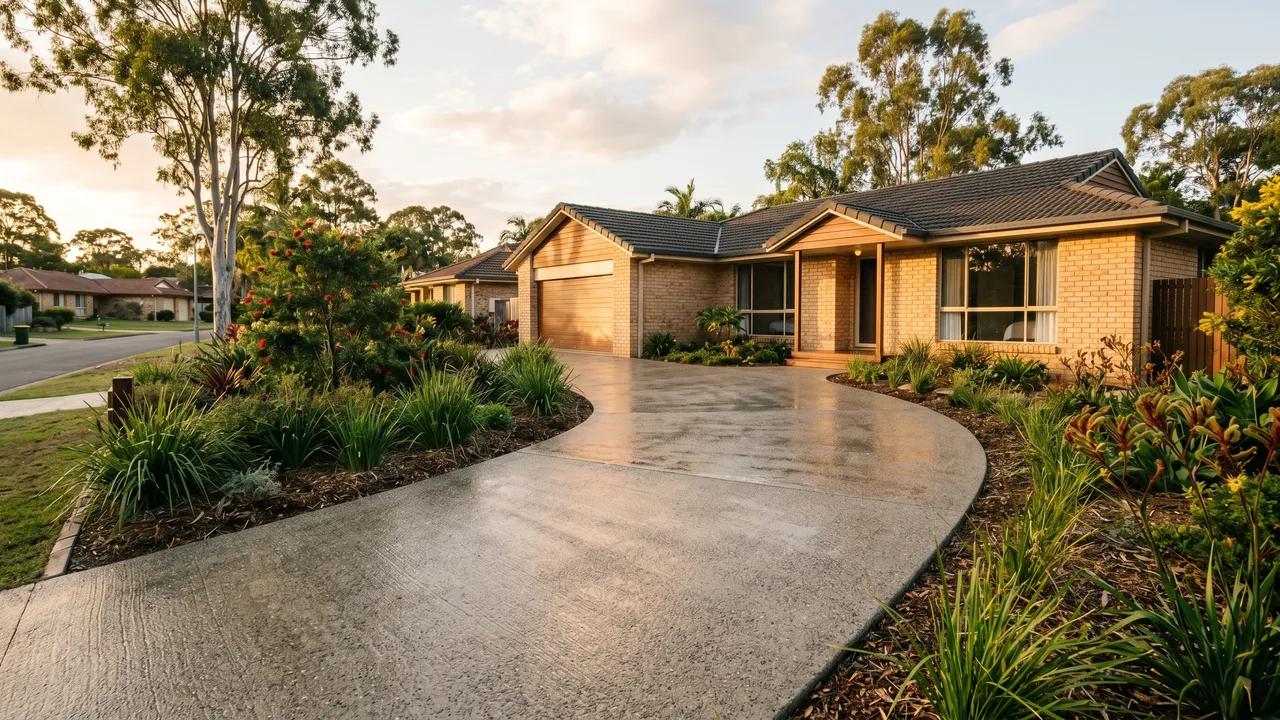
Concreting
Concrete Driveways Hemmant.
Concrete Driveways in Hemmant
A new concrete driveway is a straightforward job on paper: excavate the existing surface, prepare a compacted base, set formwork, pour and finish the concrete, then cure it properly. In practice, the details matter a lot, especially in Hemmant and the surrounding Bayside suburbs where salt air, clay subsoils and the occasional flood event all affect how a slab performs over time.
This page covers what the work actually involves, what it typically costs, and how to know whether a full new driveway is what your property needs.
What the Work Involves
A concreter installing a new driveway will typically:
- Strip and excavate the existing surface (asphalt, pavers, old concrete or compacted gravel) to a depth of around 100-150 mm
- Compact the subbase using a plate compactor, adding road base if the existing material is too loose or clay-heavy
- Set timber or steel formwork to define the slab edges and any falls required for drainage
- Install steel reinforcement (mesh or bar, depending on the design and expected loads)
- Pour and screed the concrete to a consistent level
- Finish the surface - broom finish is the most common for driveways; exposed aggregate and stencilled finishes are available as upgrades
- Apply a curing compound or cover with plastic sheeting to slow moisture loss during the first few days
Most residential driveways in Hemmant use a 25 MPa concrete mix at 100 mm thickness as a minimum. If you park a trade vehicle or boat trailer on it regularly, a concreter may recommend 32 MPa and 125 mm.
When You Need a New Driveway
Not every cracked driveway needs full replacement. Resurfacing can handle surface-level spalling and minor cracks. A full replacement makes more sense when:
- Cracks run through the full depth of the slab and are shifting or heaving
- Tree roots (including the large figs and poincianas common in older Bayside streets) have lifted sections beyond repair
- The existing slab has no proper falls and pools water at the garage entry
- You are extending the driveway or changing the layout entirely
- The original concrete was poured thin or without reinforcement and has deteriorated structurally
Bayside properties near Wynnum and Manly can also see accelerated surface degradation from salt air over many years. If the surface is soft, pitting or crumbling at the edges, that is a sign the concrete has been compromised from the outside in.
There is no fixed lifespan, but a well-poured driveway in this area typically lasts 25 to 40 years before replacement becomes necessary.
What It Costs in Brisbane
For a standard residential driveway in the Hemmant area, expect to pay roughly $85 to $130 per square metre for a plain broom-finished slab. A typical double driveway of around 40-50 m² comes to somewhere between $3,500 and $6,500 installed.
What moves the price:
- Size and shape - straight rectangles are cheaper to form than curved or tapered entries
- Excavation depth and disposal - if there is a lot of material to cart away, that adds cost
- Access - tight side entries, steep slopes or restricted truck access on narrow Bayside streets can add time and labour
- Reinforcement specification - heavier mesh or reo bar costs more than standard SL72 mesh
- Surface finish - exposed aggregate or stencilled concrete adds $20-40 per square metre on top of the base price
- Concrete pump hire - needed when the truck cannot reach the pour area directly; typically adds $300-$600
The $1,500-$15,000 range reflects everything from a small single-car entry slab to a large double driveway with a decorative finish and significant earthworks.
What Is (and Is Not) in a Typical Quote
A standard quote should include: labour, concrete supply, mesh, formwork, basic excavation and subbase compaction, and a broom finish.
It will often exclude: skip bin hire for spoil removal, tree root grinding, council crossover permits (required in most Brisbane suburbs if work touches the kerb), and any retaining or edging work. Ask about these line items before signing anything.
Council crossover permits are worth mentioning specifically. If your driveway connects to a kerb and channel on a council road, Brisbane City Council typically requires a permit and the crossover must be built to their spec. A reputable concreter will flag this; if one does not, ask.
Is a New Concrete Driveway Right for Your Property?
A few honest questions to work through:
- Is the existing base structurally sound? If yes, resurfacing may be enough.
- Are you changing the width, length or entry point? If yes, new concrete is the right path.
- Is the current surface asphalt rather than concrete? Concrete over old asphalt is possible with adequate prep, but a full strip is cleaner.
- Do you have significant level changes from the street to the garage? That affects the formwork, falls design and potentially the need for a pump.
If you are unsure, a site visit from a concreter will usually answer these questions quickly and at no charge.
A Note on Safety and Insurance
Any concreter working on your property should carry public liability insurance - $5 million is the typical minimum in Queensland. For work that touches a council road reserve (like a crossover), they should be familiar with Brisbane City Council requirements.
We connect Hemmant homeowners with local concreters who operate with current insurance and relevant experience in the Bayside area. We are a referral service, not a concreting company ourselves, so we will be upfront if a job falls outside what our network covers.
If you would like to talk through what your driveway project involves before committing to anything, a quick call is a good place to start.
Quick answers
Frequently asked.
How long does a new concrete driveway take to pour and cure in Hemmant?
Do I need a council permit for a new driveway in Brisbane?
What thickness should a residential concrete driveway be in Queensland?
How much does a double concrete driveway cost in the Hemmant area?
Can salt air near Wynnum and Manly damage a concrete driveway?
Is concrete resurfacing a cheaper alternative to a full driveway replacement?
Ready to book
Quickest is by phone.
Up-front pricing on the call. Booked in one go. No site visit needed.