Concreting guide
When should you repair your concrete driveway and when should you replace it?
Repair or Replace? Here's the Short Answer
If the damage is surface-level and the slab underneath is structurally sound, repair is usually the smarter call. If the slab is heaving, cracking all the way through, or crumbling across more than roughly a third of its area, replacement tends to cost less in the long run. Everything in between deserves a closer look.
What Kind of Damage Are You Actually Looking At?
Concrete damage falls into two broad categories: cosmetic and structural. Mixing them up is where most homeowners go wrong, either spending money on repairs that won't last, or replacing a slab that had years of life left in it.
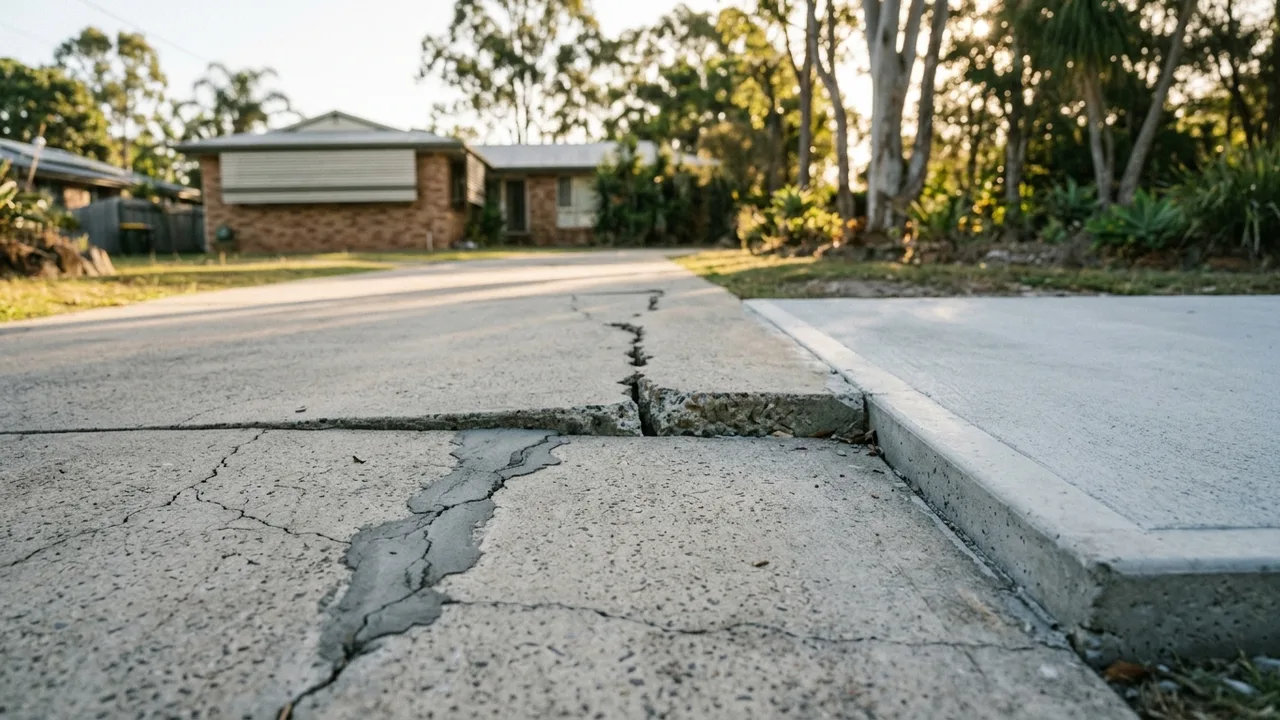
Cosmetic damage includes:
- Hairline surface cracks (less than about 3 mm wide)
- Shallow spalling, where the surface layer flakes or pops off
- Staining from oil, rust, or tannin (common under the figs and jacarandas that are everywhere in bayside Brisbane)
- Minor scaling caused by water pooling and UV exposure
Structural damage includes:
- Cracks that run the full depth of the slab
- Sections that have shifted up or down relative to each other (called displacement or differential settlement)
- Widespread crumbling or aggregate exposure that goes deeper than the surface layer
- Spongy or hollow spots when you walk across the slab, which suggest voids underneath
A simple tap test helps. Walk the driveway and knock on the surface with a hammer or a solid length of timber. A solid thud is good. A hollow, drum-like sound suggests the concrete has delaminated or there's a void beneath it, and no surface repair will fix that reliably.
Why Brisbane's Bayside Conditions Matter
Concrete in Hemmant, Wynnum, Manly, and the surrounding bayside suburbs deals with conditions that are a bit harsher than, say, inner-west Brisbane. Salt air accelerates the corrosion of steel reinforcement inside the slab. Once the reo (reinforcing steel) starts to rust, it expands and pushes the concrete apart from the inside. You'll see this as rust-coloured cracks or streaks running along what looks like a straight line under the surface.
Clay subsoils are also common across this part of Brisbane. Clay shrinks and swells with moisture changes, and that movement works its way up through the slab over time. After a dry stretch followed by heavy summer rain, don't be surprised to find new cracks that weren't there six months ago. That's not necessarily a crisis, but it does mean any repair needs to address drainage and subbase stability, not just the crack itself.
Tree roots are another bayside reality. If your driveway runs anywhere near a mature fig, poinciana, or similar species, there's a reasonable chance root intrusion is lifting or cracking the slab from below. Patching the surface without dealing with the root is a short-term fix at best.
The Repair Case: When It Makes Sense
Repairs are worth pursuing when the slab is fundamentally intact and the damage is either cosmetic or limited to isolated spots. A good concrete repair done properly, with proper crack preparation, appropriate filler, and a bonding agent to tie new material to old, can extend a driveway's life by 10 to 15 years in many cases.
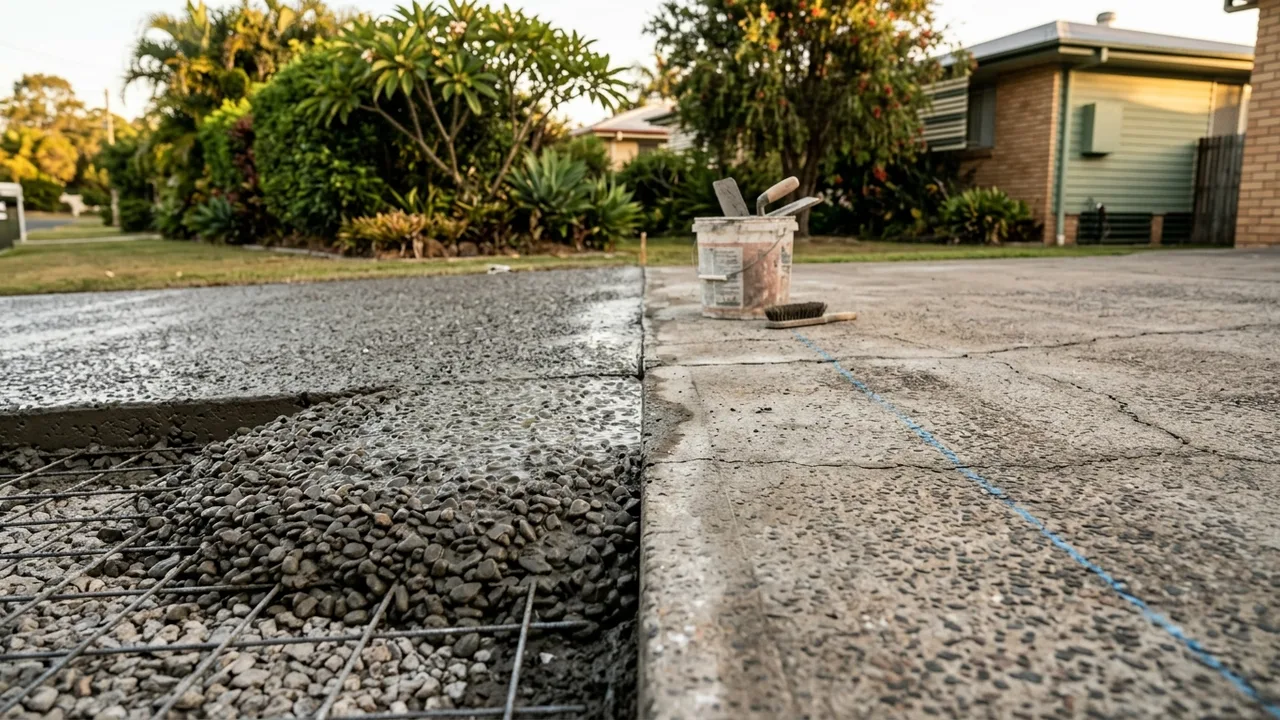
Typical repair scenarios where the numbers make sense:
- A few isolated cracks, none wider than about 6 mm, with no displacement between the two sides
- Surface spalling across one small bay of a multi-bay driveway
- A single sunken section near a downpipe where drainage improvement can be made alongside the repair
- Resurfacing a driveway that's structurally fine but looks worn and stained
Cost-wise, concrete repairs in this area typically run somewhere between $300 and $2,500 depending on the scope and surface treatment involved. That's a fraction of a full replacement, which for a standard double driveway in Hemmant or Wynnum West tends to land in the $4,000 to $9,000 range, sometimes higher for exposed aggregate or longer runs.
The honest trade-off: repaired concrete rarely looks exactly like new concrete. Colour matching is difficult, and patched areas will often be visible, especially on plain grey slab. If that bothers you aesthetically, resurfacing the whole driveway (applying a thin bonded overlay) is a middle option that gives a more uniform appearance without the cost of full demolition and replacement.
The Replacement Case: When You're Better Off Starting Fresh
Replacement makes more sense than most people initially want to hear, but there are clear situations where pouring good money into repairs is genuinely wasteful.
Replace rather than repair when:
- Cracking is widespread, covering more than roughly 30 to 40 percent of the surface
- Multiple sections have displaced, meaning the slab has moved in different directions
- The slab is older than 30 to 40 years and has had multiple repair cycles already
- Rust staining reveals corroded reo running through a significant portion of the slab
- The subbase was never properly prepared (common in some older Queenslander-era homes where driveways were laid directly on clay)
- You're planning an upgrade anyway, such as switching to exposed aggregate or extending the driveway footprint
A full replacement also gives you the chance to fix drainage properly. Many older driveways in Wynnum and Manly were laid without adequate falls toward the kerb, which means water sits on the surface and works its way through any crack it can find. A new slab, graded correctly, removes that problem.
Demolition and disposal add to the cost, typically $500 to $1,500 depending on slab thickness and access, but the result is a slab with a new 30-plus year service life if the subbase is prepared well and the concrete is properly reinforced and cured.
Getting a Quote That Actually Tells You Something
A useful quote from a concrete contractor should do more than give you a price. It should tell you what they found when they assessed the slab, what they're proposing to do about the subbase (not just the surface), and whether they've factored in drainage.
If a quote comes back without any mention of the subbase, ask directly. In bayside Brisbane's clay-heavy soils, the subbase preparation is arguably more important than the concrete mix itself. A beautifully poured slab on an unstable base will start cracking within a few years.
Also ask whether the contractor is quoting a standard 25 MPa mix or something stronger. For a residential driveway that takes regular vehicle traffic, 32 MPa is a reasonable standard in most Brisbane installations, and the price difference per metre is modest compared to the long-term benefit.
A Straightforward Recommendation
If your driveway has isolated cracks, a bit of surface wear, or a single problem area, get it assessed and, if the slab is sound underneath, repaired. The economics clearly favour it and a well-done repair will hold up.
If the damage is widespread, if you've been patching the same spots for years, or if there's evidence of reo corrosion or serious subbase movement, replacement is the more honest choice. Spending $1,500 on repairs on a slab that needs replacing in two years isn't saving money.
Either way, the most useful thing you can do is have someone who actually knows concrete walk the driveway with you and give you a straight answer. Not every crack is a crisis, and not every cheap-looking repair is a bargain. A conversation with a local contractor who works in Hemmant, Wynnum, Manly, and the surrounding bayside suburbs will give you a much clearer picture than any guide can from a distance.
If you'd like us to connect you with a vetted local concreter for an honest assessment, that's exactly what this service is here for.
Quick answers