Concreting guide
What should be done before the concretor arrives on site?
Before the concretor arrives, you need to do three things: confirm the site is clear and accessible, make sure any required permits are in hand, and agree on the mix and finish in writing. Get those three right and the job almost runs itself. Miss them and you are paying for delays out of your own pocket.
Confirm Your Council Permit Situation First
Not every concrete job in Brisbane needs a permit, but some do, and finding out on pour day is expensive. As a general rule, a like-for-like driveway replacement or a garden path typically sits below the threshold that triggers a development application (DA). A new shed slab or a large entertaining area may be a different story, depending on total impervious area, setbacks and whether the land is in a flood overlay.
For homes in Hemmant, Wynnum, Manly and the surrounding bayside suburbs, the flood overlay is worth checking carefully. Parts of these suburbs sit close to the creek and bay floodplains, and Brisbane City Council's online mapping tool can tell you whether your property triggers additional stormwater requirements. If it does, your concretor needs to know before they order materials, not after.
A private certifier or your concretor's own experience can often clarify what is and is not needed. Do not assume. A driveway that increases impervious coverage on a flood-affected lot can trigger conditions that change the drainage design entirely. Sorting this out early costs you nothing but a phone call. Sorting it out mid-job can cost hundreds in delays and re-design fees.
Mark Out the Area and Agree on Levels
Once permits are confirmed, walk the job with a tape measure and some spray paint or chalk. Mark exactly where the slab or path starts and ends. Do the same for any obstacles: garden taps, irrigation lines, drainage pits, power conduit and tree roots. In bayside suburbs like Wynnum West and Lota, older properties often have surface-laid irrigation or water lines that are not obvious until a formwork stake hits one.
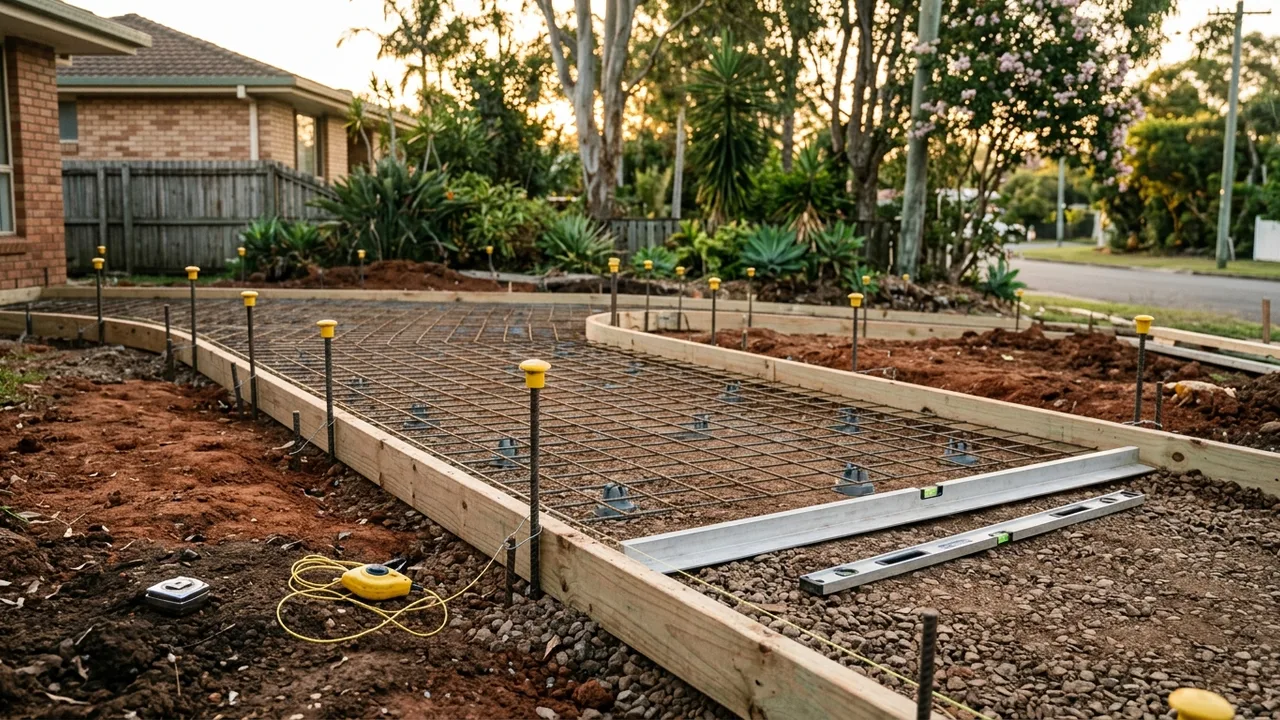
Levels matter more than most homeowners realise. Concrete needs to fall away from the house to shed water - typically a minimum 1:100 fall for slabs and 1:80 for driveways. If your site has existing paving, a step-down to the street kerb, or a neighbour's fence line that constrains where water can go, those issues need resolving before formwork goes in. Talk to your concretor about finished height relative to your internal floor level and any side-access gates. It is much cheaper to add a course of bricks to a fence post before the pour than to grind down a finished slab later.
Also note any overhead power lines if you are in an older part of Hemmant or Manly West. Concrete trucks have high chutes and the driver needs to assess clearance. Flag it when you book.
Prepare the Ground and Organise Access
The concretor will typically set and compact the sub-base, but that assumes you have already cleared the way. Before the crew turns up, you need to:
- Remove any existing plants, turf or garden edging within the marked area
- Relocate pot plants, garden furniture and anything stored along the access path
- Cut back overhanging branches that could foul the chute or the screed board
- Confirm where the concrete truck can park (they are heavy and wide, and a standard agitator truck needs roughly 2.5 to 3 metres of clear run)
- Check that the surface hardstand or verge the truck parks on can take the load - if you are on a quiet Hemmant street with a gravel verge, let your concretor know so they can arrange a pump if needed
If you have a dog or children, organise to have them off site for the whole pour day plus the following morning minimum. Fresh concrete is caustic and the work area genuinely cannot be supervised by one person while it is being placed. This is not fine print; it is a real hazard.
Salt air is a factor for jobs close to the bay in Wynnum, Manly and Lota. It does not stop you pouring concrete, but it is worth mentioning to your concretor so they can factor in appropriate curing methods and, if relevant, a sealer spec that handles the coastal environment.
Sort Out Drainage Before Formwork Goes In
This is the step most homeowners skip and later regret. Once a slab is poured, re-routing drainage is either impossible or involves breaking up what you have just paid for.
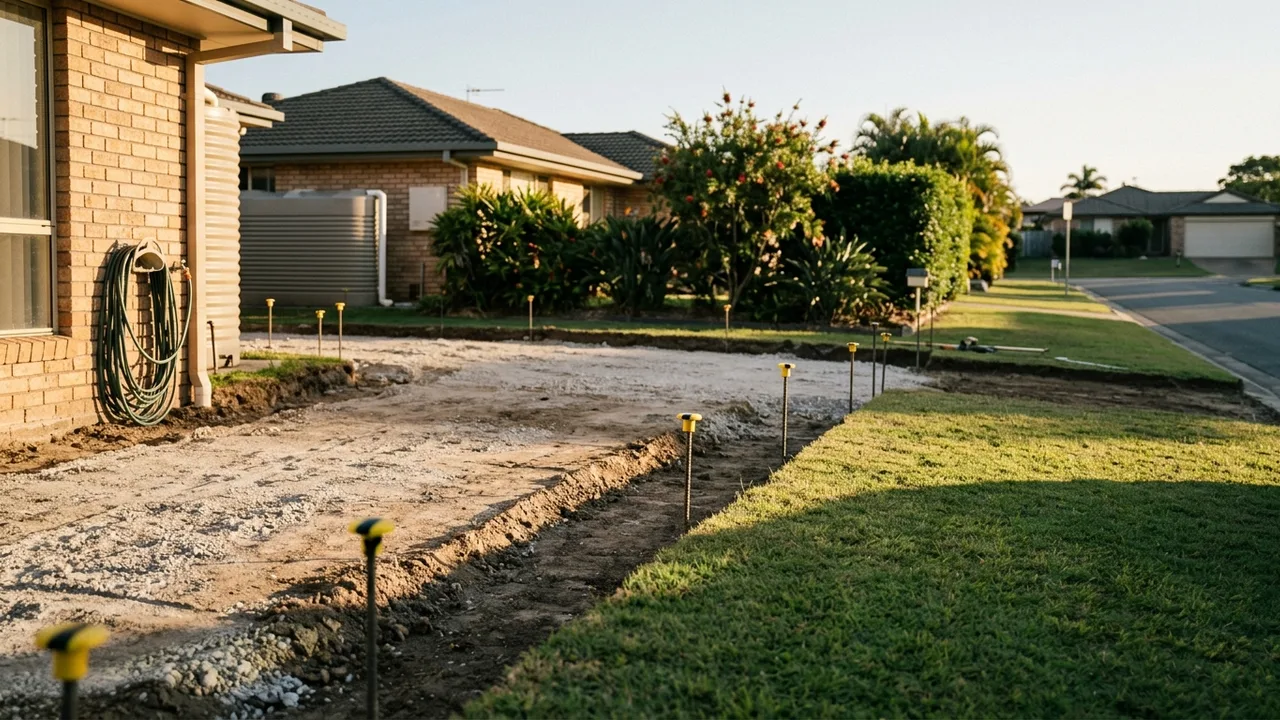
Walk the area after a decent rain and watch where water sits. If there is a low spot that pools now, concrete over the top will not fix it - it will make it worse because there is nowhere for the water to go. You may need:
- A strip drain or channel drain at the base of the driveway near the footpath
- A grated pit connected to the stormwater system
- A slight crown or cross-fall engineered into the slab design
For alfresco slabs and entertaining areas, think about where the barbecue hose bib will sit and whether you want conduit stubbed up through the slab before the pour for any future outdoor lighting or a garden tap extension. Running conduit through wet concrete takes ten minutes. Core-drilling through cured concrete costs time and money.
Finalise the Finish and Get It in Writing
Concrete offers more finish options than most people expect: plain broom finish, exposed aggregate, stencilled, honed or resurfaced over existing concrete. Each has a different cost, a different maintenance profile and different suitability for your site.
Exposed aggregate, for example, looks excellent on a Manly or Wynnum driveway but it is rougher underfoot than a broom finish. If you are going to walk it barefoot or roll a bin across it every week, factor that in. A broom finish is cheaper and easier to maintain; it just does not have the same decorative appeal.
Whatever you agree on, get it in writing before the crew arrives. A simple written scope confirming:
- The exact dimensions and location
- Reinforcement spec (mesh, steel, fibre)
- Finish type and any sealer
- Total price and payment schedule
- What happens if you hit unexpected sub-base issues
This is not about distrust. It is about making sure the concretor can brief their crew correctly and you have a reference point if there is a dispute. A professional operator will expect this and provide it without hesitation.
Have a Plan for Curing and Access Restrictions
Concrete is poured in a few hours but it needs time to reach usable strength. Foot traffic is typically possible after 24 hours; vehicle access on a driveway is usually safe after 7 days, though full design strength takes around 28 days. Those timelines can shift in hot, dry weather - which Brisbane summers deliver reliably.
If you are in Hemmant or Wynnum in January and the forecast is 35 degrees with a dry westerly, talk to your concretor about curing compound application or wet hessian curing. Rapid moisture loss causes surface cracking that cannot be reversed. This is not a rare event in bayside Brisbane; it is a realistic risk on roughly a third of summer pour days.
Plan for the fact that your driveway, path or slab will be out of action for at least a week. If you have two cars and only one can park on the street, sort out the logistics before pour day so you are not trying to problem-solve it at 7am when the truck rolls up.
Getting this right is not complicated, but it does take a couple of hours of preparation across the week or so before the job. The homeowners who have the smoothest jobs are not necessarily the ones with the most straightforward sites - they are the ones who showed up to the pre-pour conversation organised. If you want to talk through your specific site in Hemmant or the surrounding bayside area, a quick call with a local concretor who knows the ground conditions here is worth more than a lot of general reading.
Quick answers