Concreting guide
Coastal air in Manly and Wynnum speeds up concrete wear faster than you think
Salt Air Is Hard on Concrete, and Bayside Brisbane Proves It
If you live in Manly, Wynnum or anywhere close to Moreton Bay, your concrete is ageing faster than concrete two suburbs inland. That is not a scare tactic. Salt-laden air is genuinely corrosive, and the closer you are to the water, the harder it works on exposed surfaces. Understanding why this happens, and what you can do about it, saves you money in the long run.
Why Salt Air Attacks Concrete
Concrete looks solid, but under a microscope it is porous. Fresh Portland cement paste is full of tiny capillary channels left behind as mixing water evaporates during curing. In a dry inland suburb like Hemmant, those pores mostly fill with moisture during rain events and dry out between them. The cycle is relatively gentle.
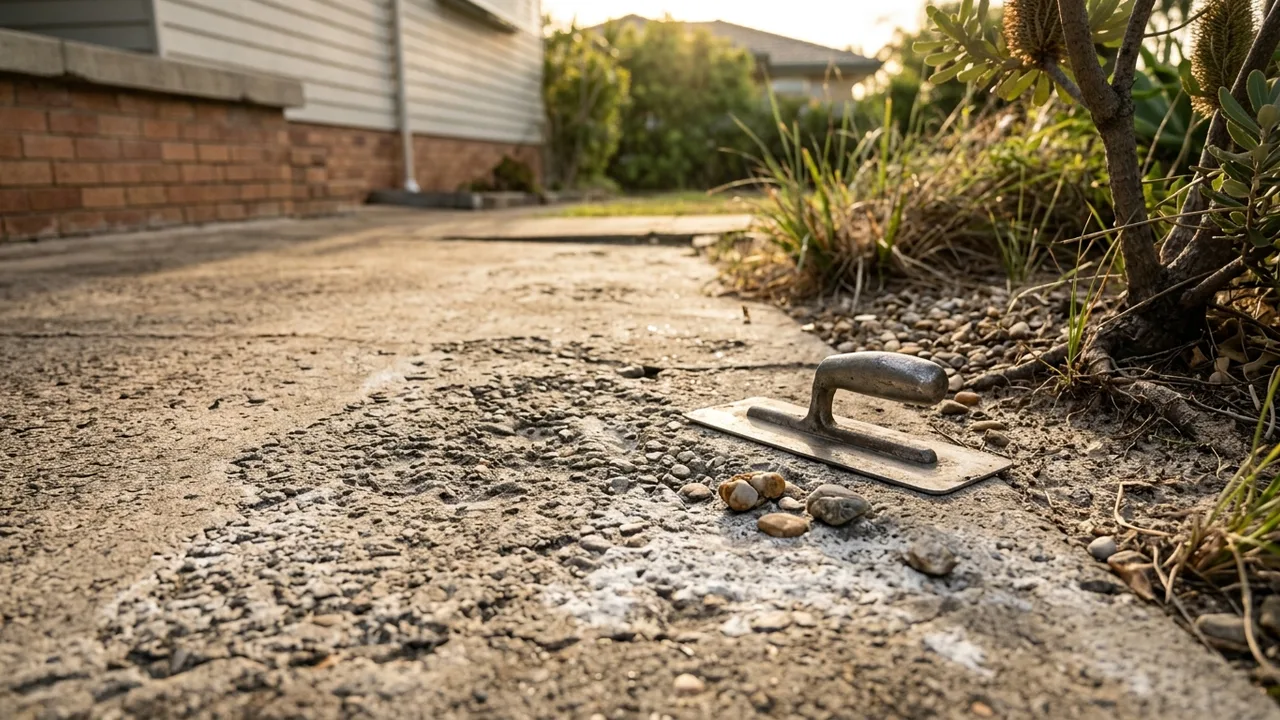
In Manly or Wynnum, the situation is different. Sea spray and salt-laden humidity push sodium chloride and magnesium sulphate into those same pores on a near-daily basis. When the surface warms up during a Brisbane summer afternoon, the moisture evaporates and leaves salt crystals behind. Those crystals expand as they form. Over hundreds of wetting and drying cycles, the internal pressure from crystal growth is enough to fracture the cement paste around the aggregate particles. The technical term is salt crystallisation attack, sometimes called subflorescence when it happens just below the surface. You see the result as surface scaling, small pop-outs and a gradually roughening texture.
The process is slow at first and then suddenly visible. A driveway that looked fine at year three can look noticeably worn by year five if nothing has been done to slow it down.
What the Bayside Exposure Zone Actually Means
Concrete durability standards in Australia (primarily governed by AS 3600 and the related exposure classifications) recognise that structures within about one kilometre of breaking surf or tidal water face harsher conditions than those further inland. Brisbane City Council's bayside suburbs sit in what engineers typically classify as an "B1" or "B2" exposure environment, depending on proximity to the shoreline and whether the site faces prevailing onshore winds.
Manly's esplanade-facing streets and Wynnum's waterfront homes are at the sharper end of that range. Lota and Manly West are slightly more sheltered but still meaningfully more exposed than, say, Tingalpa or Murarrie. Even Hemmant, which sits on the bay itself and is close to port infrastructure, has its own industrial and tidal-air considerations that differ from fully inland suburbs.
In practical terms, this means that concrete mixes designed for bayside conditions typically call for a lower water-to-cement ratio (often 0.45 or below, compared to 0.55 that might be acceptable elsewhere), a higher cement content, and sometimes supplementary cementitious materials like fly ash or slag that make the cement matrix denser. A concretor who quotes you a standard residential mix without asking about your proximity to the bay is cutting a corner you will eventually pay for.
The Reinforcement Problem Nobody Talks About
Surface wear is one issue. What happens inside the slab is another.
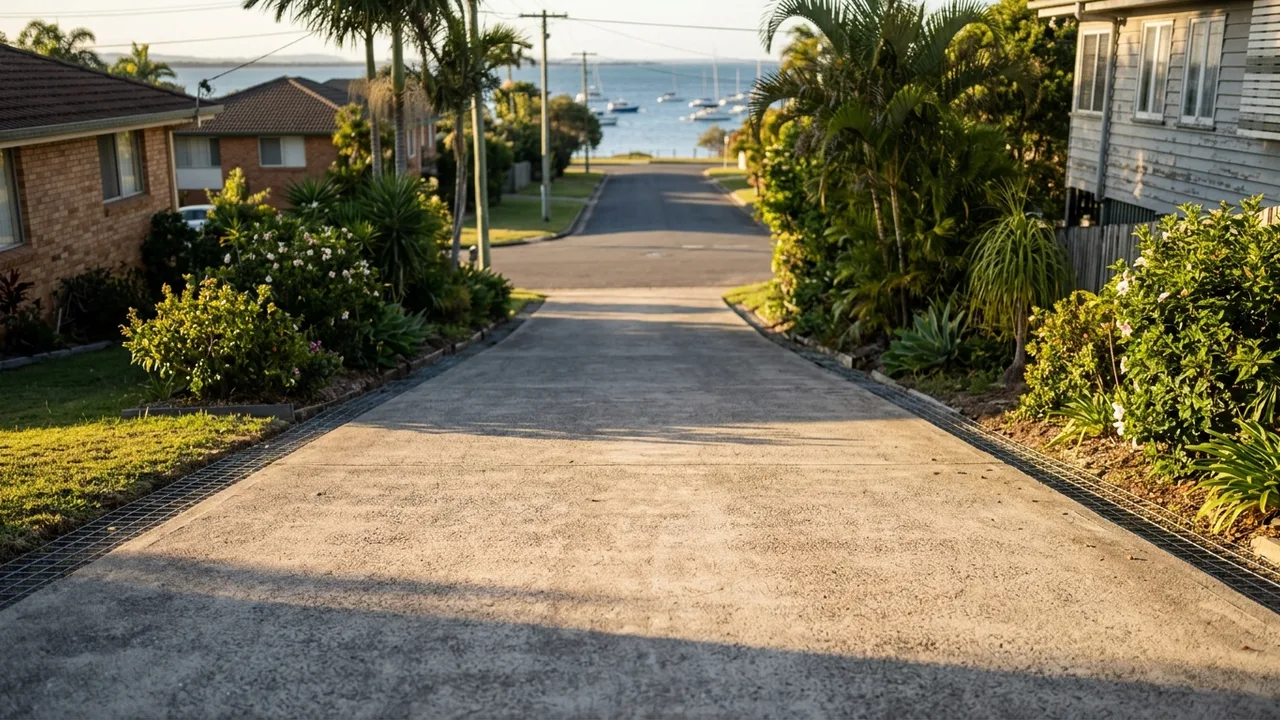
Most residential concrete slabs and driveways in Brisbane are reinforced with steel mesh or bar. Steel and chloride ions are a bad combination. Once chloride penetrates to the depth of the steel (typically 40-70 mm in a standard driveway, depending on cover), it disrupts the passive oxide layer that normally protects the steel from corrosion. The steel begins to rust, and rust occupies roughly three times the volume of the original steel. That expanding rust pushes against the surrounding concrete and causes cracking and delamination along the line of the reinforcement. In a coastal suburb, this process can begin well before the twenty-year mark if the original mix or cover depth was not specified with the environment in mind.
Epoxy-coated or galvanised reinforcement is available and is worth discussing with your concreting contractor if you are pouring a new slab near the waterfront. It costs more upfront, typically adding a few hundred dollars to a standard driveway job, but the trade-off against potential resurfacing or replacement costs in ten to fifteen years is worth working through.
Spotting Early Damage Before It Becomes Expensive
The good news is that salt attack gives you warning signs before it becomes a structural issue. Here is what to look for:
- Surface dusting or powdering. Run your hand across the concrete. If a chalky residue comes off easily, the surface paste is already degrading.
- Fine map cracking (crazing). A web of shallow cracks across the surface suggests the top layer is shrinking and losing integrity. Not always salt-related, but bayside exposure accelerates it.
- Pop-outs. Small conical holes where an aggregate particle has been ejected. Salt crystallisation pressure inside the concrete is often the cause.
- Rust staining. Brown or orange streaks running from the surface down are a signal that chloride has reached the reinforcement. This is the most serious warning sign.
- White efflorescence. Crusty white deposits on the surface. Salt-laden water is wicking through the slab and depositing minerals as it evaporates.
Any of the first three can often be addressed with a professional resurfacing system, which bonds a polymer-modified overlay to the existing slab. The fourth and fifth warrant a closer look at structural integrity before you invest in cosmetic fixes.
What You Can Do Right Now
If your concrete is already showing early signs of wear, sealing is the most accessible intervention. A penetrating silane or siloxane sealer fills the capillary pores near the surface and significantly reduces the rate at which salt and moisture enter the slab. These are not the same as topical acrylic sealers that sit on the surface and peel. Penetrating sealers chemically bond to the cement matrix and typically last five to ten years in a bayside environment before reapplication.
For exposed aggregate driveways, which are popular in Manly and Wynnum partly because the texture hides surface weathering and is naturally slip-resistant, a penetrating sealer is still worth applying even on newer work. The aggregate itself is generally durable; the cement paste binding it is the vulnerable part.
If your concrete is past the sealing-will-help stage, resurfacing with a concrete overlay is the next step before full replacement becomes necessary. A well-applied overlay extends the slab's functional life by a meaningful margin, typically eight to fifteen years depending on the system and the condition of the base slab. It is not a permanent fix, but it is substantially cheaper than breaking out and repouringat anywhere from $4,000 to $12,000 or more for a standard residential driveway in this area.
If the base slab has structural cracking, significant rebar corrosion, or areas that sound hollow when tapped (suggesting delamination), replacement rather than resurfacing is the honest recommendation. Overlaying a structurally compromised slab is money spent poorly.
A Straightforward Way to Approach This
You do not need to become an expert in concrete chemistry to protect your investment. You need two things: an honest assessment of what you currently have, and work that is specified correctly for where you live.
If you are building new, ask your concreting contractor specifically what mix strength and water-to-cement ratio they are proposing, and whether it is appropriate for a bayside exposure environment. A confident, experienced concretor will answer that question directly. If you get a vague answer, that tells you something.
If you are maintaining existing concrete, get it inspected before the damage progresses from cosmetic to structural. A sealer applied at year three or four is a fraction of the cost of resurfacing at year eight, which is itself a fraction of replacement at year twelve.
Manly, Wynnum, Lota and the surrounding bayside suburbs are genuinely beautiful places to live. The proximity to the bay is the whole point. Just know that the same air that makes those suburbs worth living in is working on your concrete in the background, and a bit of attention every few years is all it takes to stay well ahead of it.
If you would like to talk through what you are seeing on your own driveway or slab, the local providers we work with cover the bayside cluster from Hemmant through to Manly and are familiar with these conditions specifically. No obligation to get a second opinion.
Quick answers