Concreting guide
How thick does a residential concrete slab actually need to be?
For most residential jobs, a 100 mm slab is the standard starting point. That covers footpaths, alfresco areas and lightly used shed floors. Driveways and garage slabs typically need 100–125 mm, and anything carrying heavier loads pushes toward 150 mm or more. Those numbers matter less in isolation than in combination with your soil, your reinforcement and how the slab will actually be used.
Why "standard thickness" is only half the answer
Concrete thickness is one lever in a system. The other levers are the subgrade (what sits underneath), the reinforcement (steel mesh or rebar), the mix strength (measured in MPa) and the curing process. Pull any one of those levers too far in the wrong direction and you undo the benefit of getting the thickness right.
A 100 mm slab over well-compacted, stable fill will outperform a 125 mm slab poured straight onto loose topsoil. That is not a reason to skip thickness; it is a reason to think about all the variables together.
In Brisbane's Bayside suburbs, including Hemmant, Wynnum, Manly and Lota, the soil picture is mixed. Some pockets sit on stiff clay or well-drained sandy loam. Others, particularly low-lying lots closer to the waterfront, have softer, reactive soils that move with moisture. That movement is one of the main reasons slabs crack, and it is why a concreter working in this area should be assessing the subgrade before quoting a thickness, not after.
Thickness by application: what the numbers actually mean
Here is how residential applications typically break down:
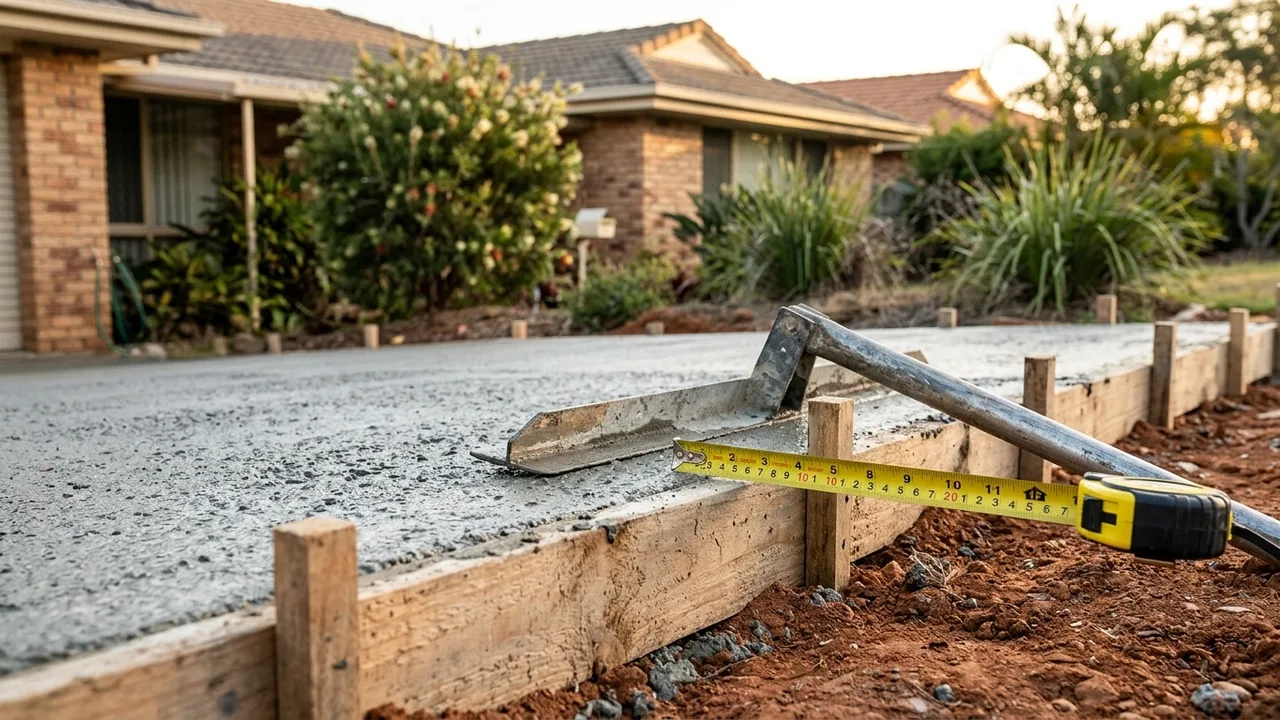
Footpaths and garden paths
- 75–100 mm is common for pedestrian-only paths.
- F62 mesh (the standard light reinforcement sheet) is adequate in most cases.
- Thinner than 75 mm and you start losing edge strength, especially if the path borders a garden bed and roots get underneath.
Alfresco and entertaining slabs
- 100 mm is the typical residential spec.
- If you are placing heavy outdoor furniture, a built-in kitchen or a spa on the slab, 100 mm with SL72 mesh is a reasonable baseline. Discuss any point loads with your concreter.
Driveways
- 100 mm is the common Brisbane residential spec for a single car.
- A double driveway or one that will regularly carry an SUV, ute or van is better at 100–125 mm.
- If a concrete truck, skip bin or any commercial vehicle will ever pull onto it, bump that to 150 mm with reinforcement reviewed.
Garage and shed slabs
- 100 mm suits a standard domestic garage.
- A workshop with a car hoist, heavy machinery or storage racking anchored to the floor needs 125–150 mm minimum, with rebar rather than just mesh in many cases.
- For a steel-framed shed with posts bearing directly on the slab, those post locations may need thickened edge beams or isolated pads, not just a uniform pour.
Suspended or step-down slabs
- These are a different category entirely and beyond simple thickness rules. A structural engineer's specification applies here.
The soil factor: why Bayside Brisbane adds a wrinkle
Brisbane's eastern suburbs sit on a mix of geological types. Much of the flat land around Hemmant, Wynnum West and parts of Manly West was historically low-lying and has been filled over decades. Fill quality varies enormously. Some lots have well-compacted, engineered fill. Others have whatever was tipped there before council oversight tightened up.
Reactive clay is also common in this part of Brisbane. Reactive clay shrinks when dry and swells when wet. The wet seasons here are genuine; a dry summer followed by a heavy subtropical downpour is a real slab-stress cycle. That moisture variation, combined with the salt air that affects properties within a kilometre or so of Moreton Bay, can also accelerate corrosion of reinforcement if the cover (the concrete depth between the steel and the surface) is inadequate.
The practical upshot: on a Bayside lot with any sign of soft or reactive soil, a competent concreter will typically recommend 100 mm minimum for paths and 125 mm for driveways and garage slabs, along with proper subgrade preparation. Skimping on either to save money is where most problem slabs originate.
Reinforcement: the partner to thickness
A thicker slab without reinforcement is not necessarily stronger than a thinner slab with proper steel. Concrete handles compression well and tension poorly. Steel handles tension. Together they cover both.
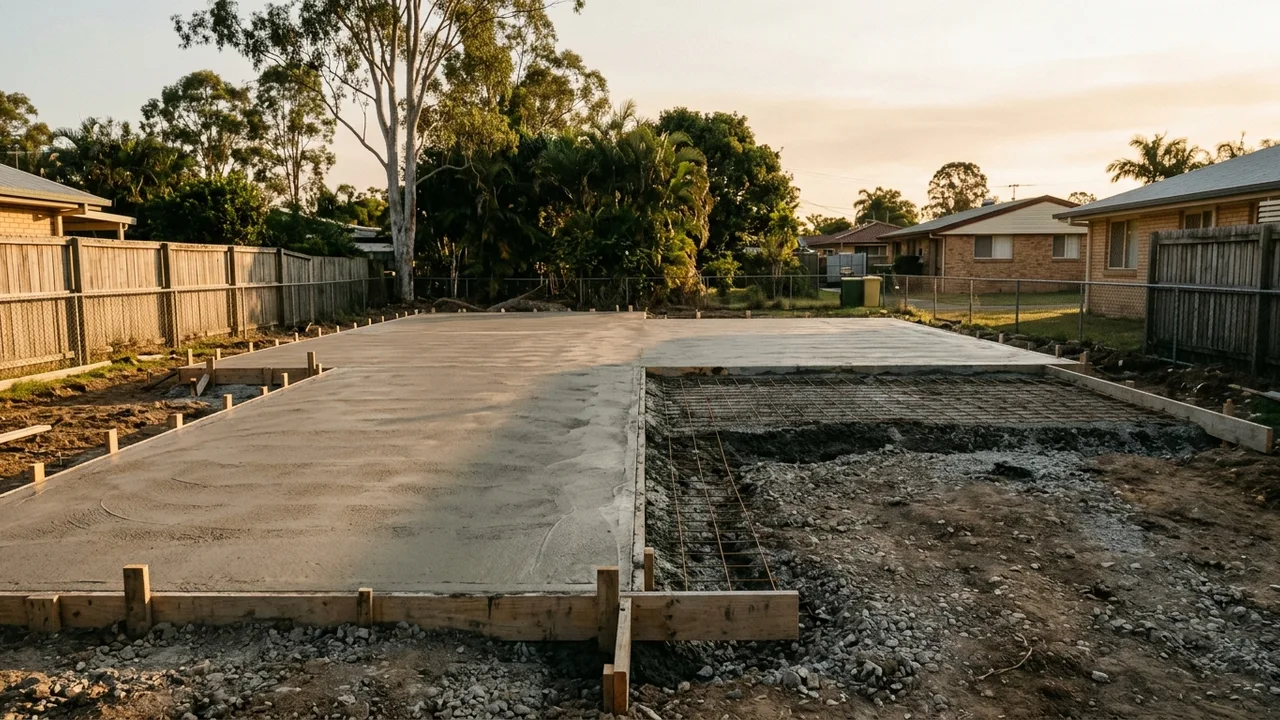
For residential work in Brisbane, the most common reinforcement options are:
- SL62 / F62 mesh - a light welded wire mesh, suitable for paths and low-load areas.
- SL72 / F72 mesh - a heavier mesh, used for driveways, alfresco areas and standard garage slabs.
- Rebar (deformed bar) - used where loads are higher, edge conditions are complex, or the engineer specifies it. Workshop slabs and large garage slabs often call for rebar rather than or in addition to mesh.
The mesh or rebar needs to sit at roughly the mid-depth or slightly below centre of the slab, held up by bar chairs. Mesh lying flat on the ground is not reinforcing the slab; it is just steel buried in concrete. This is a common DIY mistake and it is worth confirming with your concreter how they handle placement.
The cost trade-off: going thicker vs getting the subgrade right
Adding 25 mm to a slab across a 40 m² driveway means roughly an extra 1 cubic metre of concrete. At current Brisbane ready-mix prices (typically $200–$260 per cubic metre for standard residential mixes, though prices move), that is $200–$260 extra in material alone, plus some additional labour.
That is not a large sum compared to the cost of a slab that cracks, settles or needs resurfacing within five years. But it is worth knowing that spending that same money on proper subgrade compaction, moisture barriers where needed and correct reinforcement placement will often do more for the long-term outcome than simply adding thickness.
The honest answer is: do both where the site warrants it. A good concreter will tell you when the soil beneath your slab needs more preparation and factor that into the quote. If a quote does not mention subgrade preparation at all, it is worth asking about it.
What to ask before signing a quote
You do not need to be a concrete expert to ask sensible questions. These are worth raising:
- What thickness are you quoting, and what is that based on for my site?
- How will the subgrade be prepared before the pour?
- What reinforcement mesh or rebar are you using, and how will it be supported during the pour?
- What MPa mix are you specifying? (For reference, N25 is common for residential driveways and slabs; N20 is used for lighter applications.)
- Is a moisture barrier (polythene sheeting under the slab) included?
- How will you handle control joints to manage cracking?
A concreter who answers these clearly and specifically is showing you they know their work. Vague answers to specific questions are a flag worth noting.
The bottom line
For most homes around Hemmant, Wynnum, Manly and Lota, you are looking at 100 mm for paths and alfresco areas, and 100–125 mm for driveways and garage slabs, with appropriate mesh reinforcement and decent subgrade prep. Those numbers can shift depending on your soil, your load requirements and what is already on site.
Getting a quote from someone who actually looks at the ground before they give you a number is worth more than any rule of thumb in an article. If you would like to be connected with a local concreter who works in your suburb and can assess your specific site, that is what this service is here for.
Quick answers