Concreting guide
Hemmant soil conditions make concreting harder than most suburbs
Hemmant soil is genuinely difficult to concrete on. The ground beneath much of the suburb is reactive clay, often sitting close to the surface, and that single fact changes almost every decision a concreter needs to make before a barrow of concrete is poured.
If you've had quotes that seem high compared to a friend's driveway in, say, Paddington or Tarragindi, the soil is probably a large part of why.
What Makes Hemmant's Soil Different
Hemmant sits in the Bayside corridor of Brisbane's east, and the geology here reflects its history as low-lying land close to Moreton Bay. Much of the suburb sits on marine clay deposits, sometimes described on geotechnical reports as Class M or Class H reactive sites. That classification comes from the Australian standard for residential footings (AS 2870), and it tells you how much the soil is expected to move as it wets and dries.
In a Class M site, the soil might move 20 to 40 millimetres over a season. In a Class H site, movement can exceed 40 millimetres. For comparison, the sandstone-based soils in Brisbane's Inner West (Paddington, Auchenflower, Bardon) tend to sit in the Class S (slightly reactive) range. Less movement, simpler slab design, lower cost.
The clay in Hemmant also has a high shrink-swell capacity. During dry summers it can crack and pull away from the underside of a slab. During wet seasons it swells back. Over several years, this cycle puts concrete under repeated stress, which is why poorly specified slabs in this area crack earlier than homeowners expect.
How Clay Soil Changes the Concreting Process
On a stable site, a concreter can prepare a sub-base, pour, reinforce, and finish with a fairly standard process. On a reactive clay site like Hemmant, several steps either change or get added.
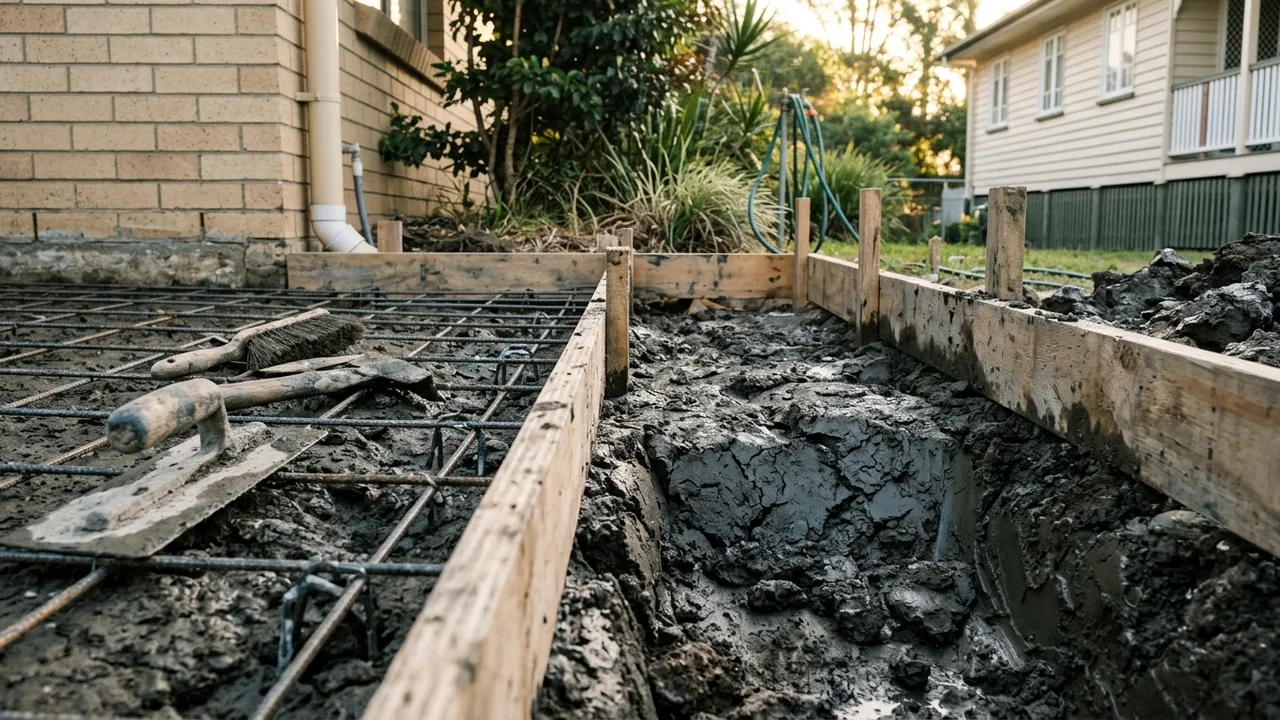
Sub-base preparation is more involved. Soft or highly plastic clay typically needs to be excavated deeper than on stable ground. In some cases, the clay is removed and replaced with a compacted sand or gravel layer to create a more stable working base. That material costs money, and so does disposing of the excavated clay if trucks are needed.
Reinforcement requirements increase. Steel mesh (SL72 or SL82) is common on standard residential slabs, but on reactive sites concreters often specify thicker mesh, closer bar spacing, or the addition of steel fibre in the mix. Some jobs in Hemmant warrant a full engineer-designed slab rather than a prescriptive residential spec. Engineer fees add to the upfront cost but are usually worth it for anything structural, like a garage or workshop slab.
Concrete mix design matters more. Higher-strength concrete (typically 32 MPa or above instead of the standard 25 MPa for residential paths) is often recommended on reactive ground because it resists cracking under movement better. This increases the material cost per cubic metre.
Control joints need careful placement. Joints cut into a slab give it a place to crack in a controlled, straight line rather than randomly across the surface. On reactive clay, joint spacing is usually tighter. A concreter skipping or spacing these incorrectly on Hemmant ground is taking a shortcut that often shows up as cracking within two or three years.
The Salt-Air Factor in Bayside
Hemmant is close enough to Moreton Bay that salt-laden air is a real consideration, particularly for exposed aggregate finishes and steel reinforcement. Salt accelerates the corrosion of steel bar and mesh if the concrete cover (the depth of concrete above the steel) is inadequate.
For context, concrete standards in Australia distinguish between exposure classifications. Inland Brisbane suburban sites are typically B1 exposure. Bayside suburbs like Hemmant, Wynnum, Manly and Lota edge toward B2 classification depending on proximity to the water. A B2 exposure classification typically requires greater concrete cover over reinforcement (40 mm rather than 30 mm) and, in some cases, a denser concrete mix.
This is worth raising directly with any concreter you bring to site. Ask what exposure classification they're designing to and why. A concreter familiar with Bayside work will have an immediate answer.
Practical Trade-offs for Homeowners
Knowing the soil is reactive gives you a few real decisions to make.
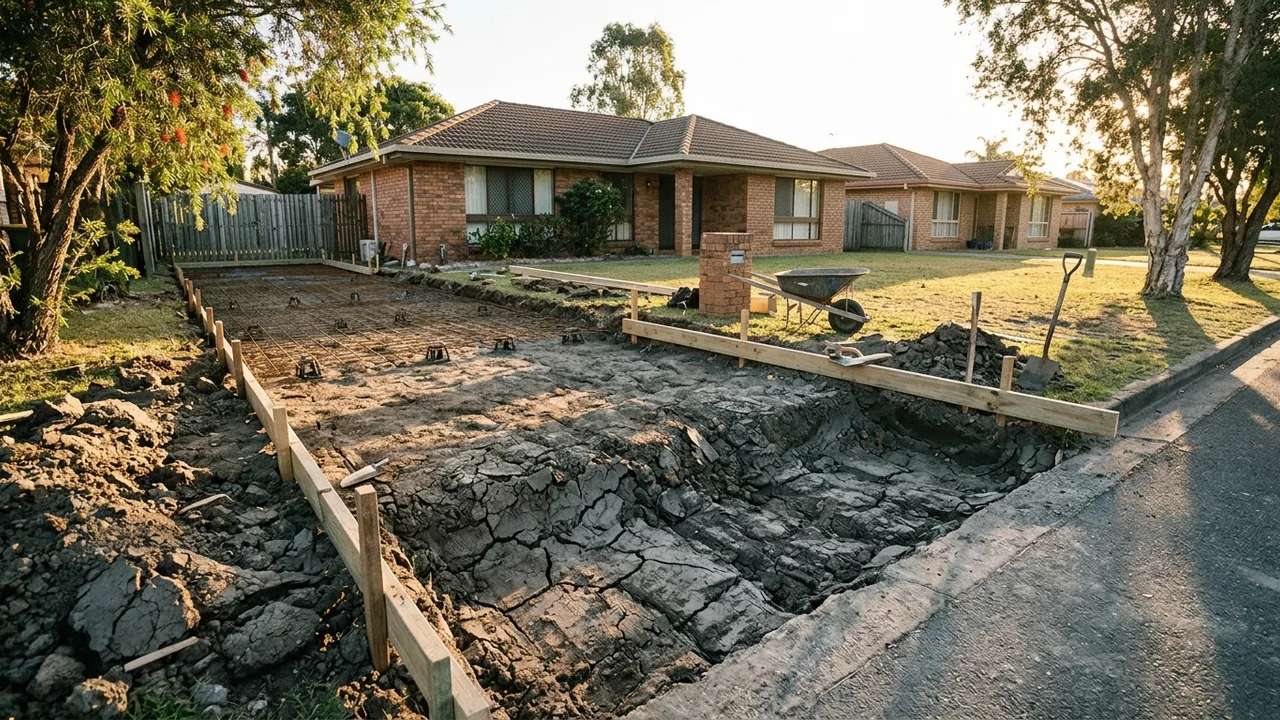
Getting a soil test versus assuming. A basic soil test from a geotechnical firm costs roughly $500 to $1,500 depending on scope. For a shed slab or a driveway under $5,000, some homeowners skip it and accept the risk. For a large alfresco slab, a garage slab, or any structure that will support a building, a test is hard to argue against. It removes guesswork from the slab specification and gives the concreter something to work from.
Standard spec versus engineer-designed slab. An engineer-designed slab costs more to specify (typically $400 to $900 for a residential concreting project) but often uses material more efficiently than a prescriptive over-spec. It can also protect you if something goes wrong later; a documented design gives you a clear reference point for any warranty conversation.
Cheaper quotes versus adequate preparation. On reactive soil, a quote that looks attractive because it skips sub-base replacement or uses lighter reinforcement is not necessarily a saving. If a slab cracks badly within a few years, resurfacing starts at around $1,500 and a full re-pour can push past $10,000. The preparation that reactive soil needs is not padding; it's the job done properly.
What to Ask a Concreter Before You Sign Anything
Because Hemmant's conditions require specific knowledge, the conversation before you hire matters. A few questions worth asking directly:
- Have you poured slabs in Hemmant or nearby Bayside suburbs before?
- What site classification are you designing this slab for?
- Will you excavate and replace the sub-base, or work over existing ground?
- What mesh or reinforcement specification are you using, and why?
- How are you handling control joints on this job?
- What's your concrete strength (MPa) and why have you chosen it?
You're not trying to catch anyone out. You're checking that the person quoting has thought through the specific conditions, not just applied a generic residential concreting template.
A Closing Thought
Hemmant is a perfectly concrete-able suburb. Plenty of driveways, garage slabs, paths and entertaining areas have been poured here that are holding up well years later. The soil conditions just mean the job needs to be approached with a bit more care and a bit more material investment than you might need in other parts of Brisbane.
The homeowners who run into problems are usually the ones who chose the lowest quote without understanding why it was lower, or who skipped the site preparation step to save a few hundred dollars upfront.
If you'd like to talk through your specific job and get connected with a concreter who works regularly in Hemmant and the surrounding Bayside area, we're happy to help with that. No pressure, just a useful conversation.
Quick answers