Concreting guide
What should you actually compare when you get concrete quotes?
What you actually need to compare when concrete quotes land in your inbox
When you get two or three concrete quotes back, the honest answer to "what should I compare?" is: almost everything except the bottom-line number. Price matters, but it is usually the last thing that should drive your decision. The quotes that look comparable on paper are often priced against completely different scopes of work, material specs, and site conditions.
Here is how to read them properly.
Scope of work: are they quoting the same job?
This is where most quote comparisons fall apart. One tradie quotes to pour a 40 mm slab; another quotes 100 mm. One includes excavation and spoil removal; another assumes you have already sorted that. One price covers a plain broom finish; the other assumes exposed aggregate. They look like they are competing on price, but they are not quoting the same job at all.
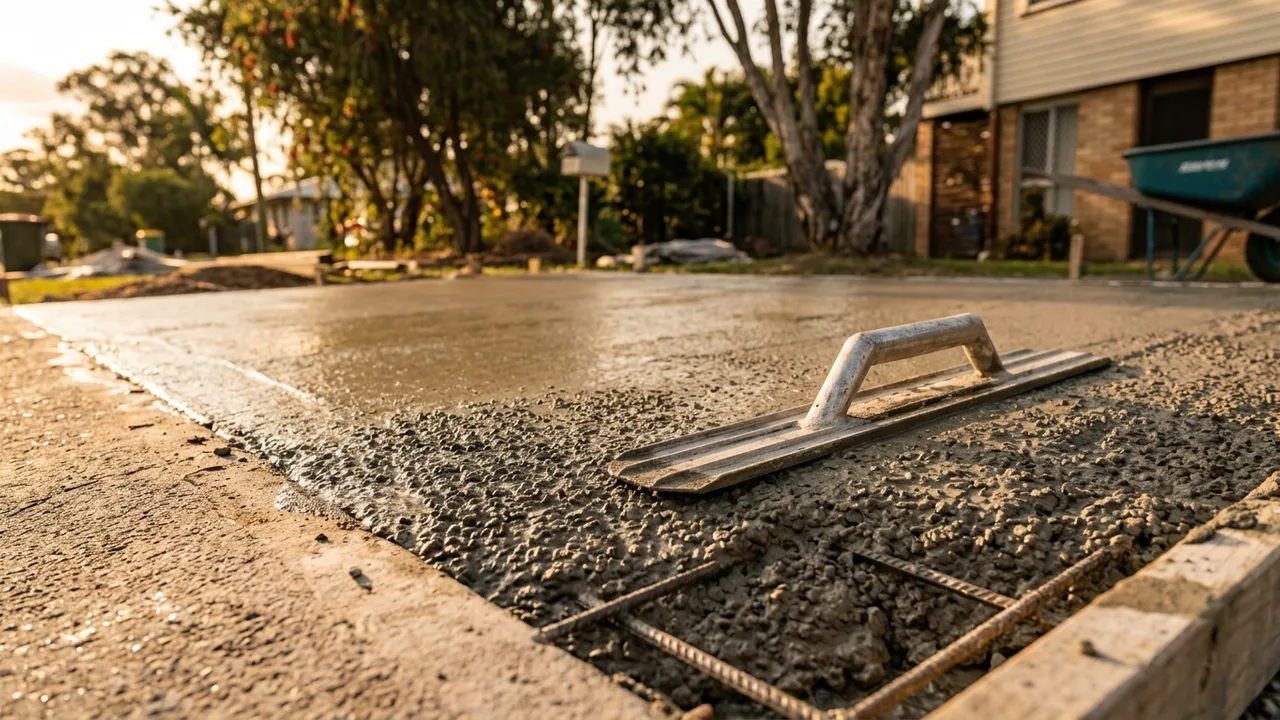
Before you line up the totals, go line by line through each quote and check:
- Exact area (square metres). Ask each contractor how they measured it.
- Slab depth. For a standard driveway in Hemmant or Wynnum, 100 mm is typical for regular passenger vehicles. If you are planning to park a ute, trailer or camper on it regularly, 125 mm is worth asking about.
- Excavation and spoil removal. Digging out existing material and carting it away is a separate cost in many quotes. Confirm whether it is included or noted as an extra.
- Subbase preparation. Will they compact a road base layer underneath? What thickness?
- Finish type. Broom finish, exposed aggregate, stencilled, plain float finish, and spray-on texture are all different products and different prices. If you are after exposed aggregate and one quote is for broom finish, you are not comparing anything meaningful.
- Formwork and edging. Some quotes bundle this; others do not.
If any of these are missing from a written quote, ask. A tradesperson who cannot answer clearly in writing is telling you something.
Concrete mix and reinforcement specs
The mix design and reinforcement used in your slab will determine how long it lasts, full stop. This matters more in bayside suburbs like Manly, Lota and Wynnum, where salt air is a genuine factor. Salt accelerates corrosion of steel reinforcement, so the cover depth over rebar (how deep the steel sits below the surface) and the concrete grade both matter more here than they would for an inland property in, say, Kenmore.
Concrete grade is expressed as N-class (normal class) with a number. N20, N25 and N32 are the common residential grades. For a driveway, N25 is typically the minimum you want; N32 is better if you expect heavier vehicle loads. Ask each contractor what grade they are specifying and why.
Reinforcement type. Most residential slabs use either steel mesh (SL72, SL82) or steel rebar (deformed bar). Reinforced is better than unreinforced for anything beyond a basic garden path. Ask what they are including, not just "it's reinforced."
Fibre additives. Some concreters add polypropylene fibres to the mix for crack resistance. This is not a replacement for steel reinforcement, but it is a reasonable addition for a patio or path.
If a quote is significantly cheaper than the others, concrete grade and reinforcement are the first two places to check.
Site conditions specific to your block
Brisbane's bayside cluster, from Hemmant through to Manly West and Wynnum, has some consistent site challenges that affect price and long-term outcome. Not every block has them, but they are common enough to be worth checking.
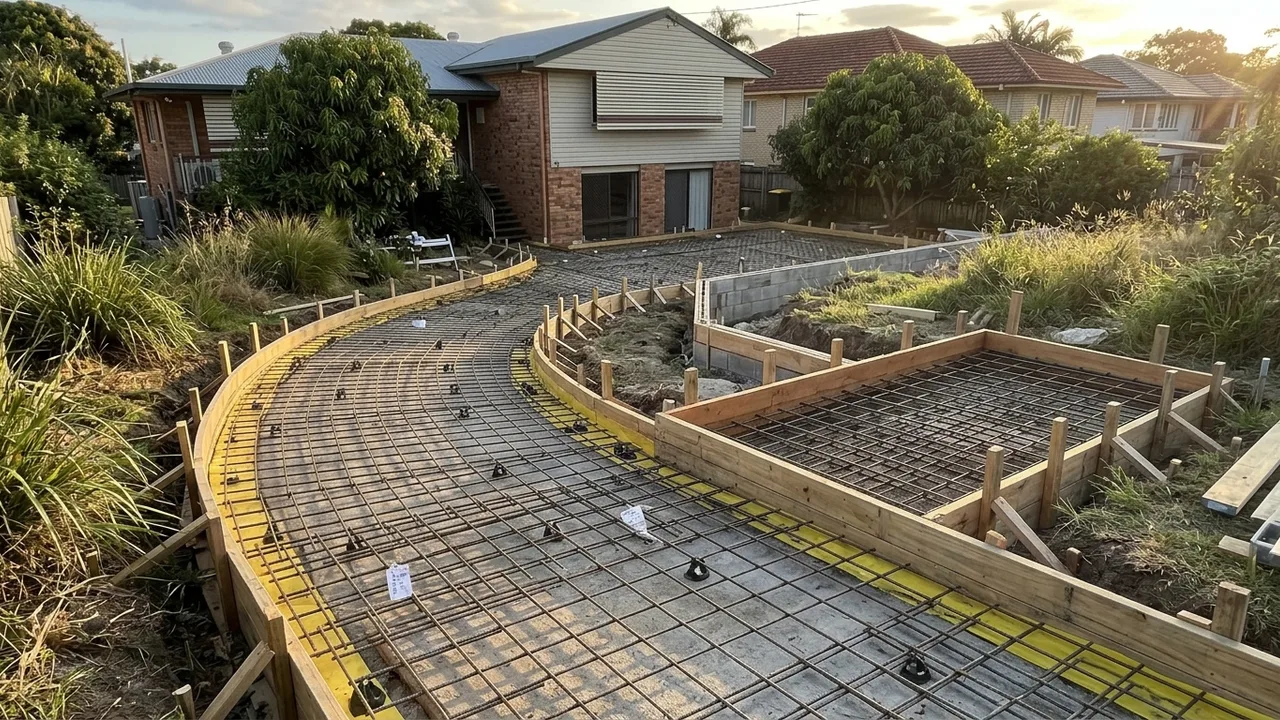
Clay soils. Much of this area sits on reactive clay. Reactive clay expands when wet and shrinks when dry, and it can move a slab if the preparation is not right. A proper subbase with compacted road base helps buffer movement. Ask how the contractor handles reactive clay on site.
Tree roots. Established poinciana, fig and mango trees are common in older Bayside backyards. Roots will eventually crack concrete placed too close. A good contractor will flag this before quoting rather than after the pour. If you have mature trees nearby, raise it directly and see what answer you get.
Slope and drainage. Many blocks in Wynnum West and Lota have moderate slopes. Retaining, step-downs, and drainage channels are legitimate extra costs. Make sure each quote either accounts for these or explicitly excludes them with a note about what that means for your budget.
Existing concrete removal. If you are replacing an old driveway, demolition and disposal is a real cost, typically $50 to $100 per square metre depending on thickness and access. Confirm whether it is in scope.
Payment terms and what they tell you
Payment schedules in a concrete quote are a reasonable signal of a contractor's cash flow and operating style. A legitimate contractor will typically ask for a deposit (often 20 to 30 per cent) before materials are ordered, with the balance on completion or within a short period after.
Be cautious if:
- A quote asks for more than 50 per cent upfront before any work starts.
- There is no mention of payment terms at all.
- The contractor asks for cash only with no receipt offered.
This is not about being suspicious of every tradie. Most are doing the right thing. But for a job worth anywhere from $1,500 to $10,000 or more, you want a paper trail and a payment structure that keeps both parties honest.
Warranty, finish standards and what happens if something goes wrong
Concrete does crack. The question is whether it cracks in a way that was preventable and whether the contractor stands behind their work if it does.
A reputable operator will typically offer some form of workmanship warranty. Ask each contractor:
- What does your warranty cover, and for how long?
- Who do I contact if I see cracking or surface defects within the first year?
- Are you licensed with the Queensland Building and Construction Commission (QBCC)?
QBCC licensing is a real indicator of accountability in Queensland. Licensed contractors are subject to a complaints and disciplinary process. That is worth knowing before you hand over a deposit. You can verify a QBCC licence number on the commission's public register.
Also ask about control joints, the deliberate cuts made in a slab to direct where cracking happens. A concreter who skips or spaces them incorrectly is taking a shortcut that shows up later. On a standard driveway, control joints are typically cut every three to four metres.
Timing, weather and scheduling reality
In Hemmant and the surrounding bayside suburbs, summer brings real challenges for concrete pours: high humidity, afternoon storms, and heat that can accelerate the curing process in ways that affect surface finish and long-term strength. Most experienced concreters in this area prefer to pour in the cooler months or schedule starts for early morning.
Ask each contractor when they realistically expect to schedule your job. If someone is promising you a pour date two weeks away in January during a wet spell, that is worth questioning. Rushing a pour to meet an unrealistic schedule rarely ends well.
Also confirm cure time: concrete should be kept moist for at least three to seven days after pouring. Ask whether curing compound, wet hessian or plastic sheeting is included in their process.
How to make the final call
Read each quote as a document. If it is vague, ask for specifics in writing. Compare the same scope, the same material grade, and the same inclusions. Once you are actually comparing like for like, the price difference between quotes often narrows significantly, or the cheaper quote reveals exactly where it is cutting corners.
The best value is not always the lowest number. A slab that lasts fifteen years in Bayside conditions, poured properly on reactive clay with the right reinforcement and finish, is worth more than a cheaper pour that cracks in three.
If you want a second opinion on what a quote should include for your specific site and suburb, that is exactly the kind of question worth making a quick call about before you sign anything.
Quick answers