Concreting guide
Exposed aggregate or plain concrete: which one suits a Bayside home?
Both finishes can work well on a Bayside property. The honest answer is that exposed aggregate handles the coastal environment a little better out of the box, but plain concrete is cheaper upfront and perfectly serviceable when it's sealed and maintained. Which one suits your block depends on budget, use, and how much ongoing care you want to do.
What the Bayside Environment Actually Does to Concrete
Suburbs like Wynnum, Manly, Lota, and Hemmant sit close enough to Moreton Bay that salt air is a real factor, not just a talking point. Salt doesn't destroy concrete overnight, but it does accelerate surface deterioration, particularly at the paste layer that sits on top of a standard broom-finished slab. Over time, especially on an unsealed or poorly sealed surface, you can expect:
- Surface dusting and chalking
- Fine cracking where the paste has dried out and contracted
- Spalling, where small flakes lift off the face of the slab
- Staining from salt residue and organic matter (Norfolk Island pines, anyone?)
High humidity and the freeze-thaw cycle aren't really Brisbane's problem the way they are in Melbourne or the Tablelands. But UV intensity here is significant, and that matters for sealers. A sealer that lasts four or five years in Toowoomba might need reapplication every two to three years in Wynnum.
Plain concrete isn't defenceless against this. Good mix design, adequate reinforcement, and a penetrating sealer applied while the slab is still relatively young give plain concrete a fighting chance in a salt-air environment. But it does require that upkeep.
How Exposed Aggregate Concrete is Different
Exposed aggregate concrete (sometimes called washed aggregate or pebble-top) is made by seeding decorative stone into the top of a fresh pour, then washing or brushing back the surface paste before it fully sets. What you're left with is a textured surface of embedded pebbles or crushed stone, with very little of the smooth cement paste exposed to the elements.
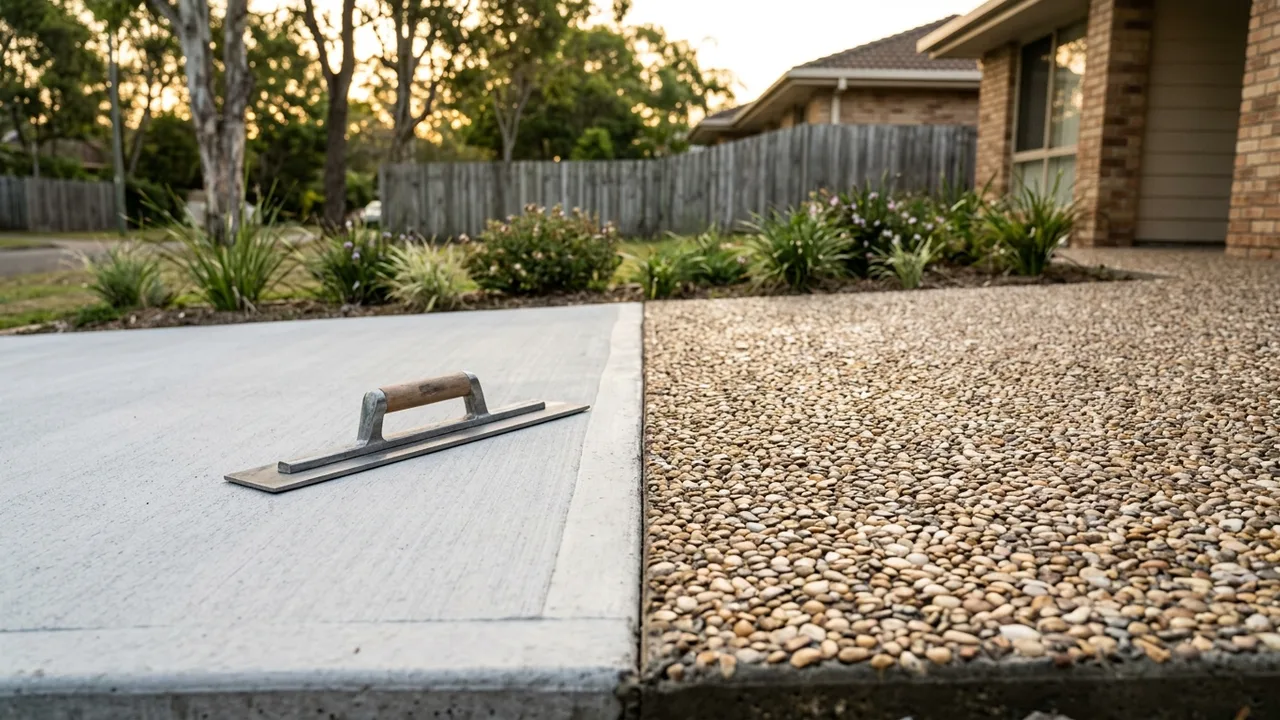
That texture is the practical advantage. Because the paste is largely removed from the top surface, there's less material available to dust, chalk, or spall. The aggregate itself, typically a hard river stone or granite, is far more weatherproof than the paste matrix that surrounds it.
There's also a slip-resistance benefit. Around pools, on sloped driveways, or on pathways that catch afternoon rain, that naturally textured surface gives better grip underfoot without needing anything added to the mix. For a Manly or Wynnum home with a sloped block running toward the street, that's worth thinking about.
The trade-off is cost. Exposed aggregate typically runs higher per square metre than plain concrete, because the job takes more labour (timing the wash-back is a skill), and quality aggregate is not cheap. As a rough guide for Bayside jobs, you might expect to pay somewhere in the $80 to $130 per square metre range for exposed aggregate versus $60 to $100 for a standard broom-finish driveway, though those numbers shift depending on site access, slab thickness, and finish quality. Always get a written quote for your specific block.
Plain Concrete: Where it Still Makes Sense
Plain broom-finish or steel-trowel concrete isn't the less glamorous option just because it costs less. There are situations where it's genuinely the better call.
Shed and garage slabs. If you're pouring a slab for a backyard shed or a garage in Hemmant or Wynnum West, decorative finish is irrelevant. A well-reinforced plain slab does the job, holds up under vehicle loads, and doesn't cost you extra for a surface that's going to be covered or largely hidden from view.
Tight budgets. A driveway replacement or new patio is typically a $3,000 to $12,000 project in this cluster. If budget is genuinely constrained, a properly sealed plain concrete driveway maintained well will give you fifteen or more years of service. It's not the wrong choice; it's a reasonable one.
Contemporary home aesthetics. Some newer builds and modern renovations in Wynnum and Manly West suit a smooth, clean concrete look. Polished or honed finishes are possible with plain concrete and can look deliberately considered rather than plain.
The maintenance obligation is the honest caveat. Plan to reseal a plain concrete driveway every two to four years in a coastal suburb. Skip that and you're accelerating the deterioration curve, especially if you have a jacaranda or fig overhanging the slab.
Comparing Long-Term Costs
It's worth thinking about this over a ten-year window rather than just the day of the pour.
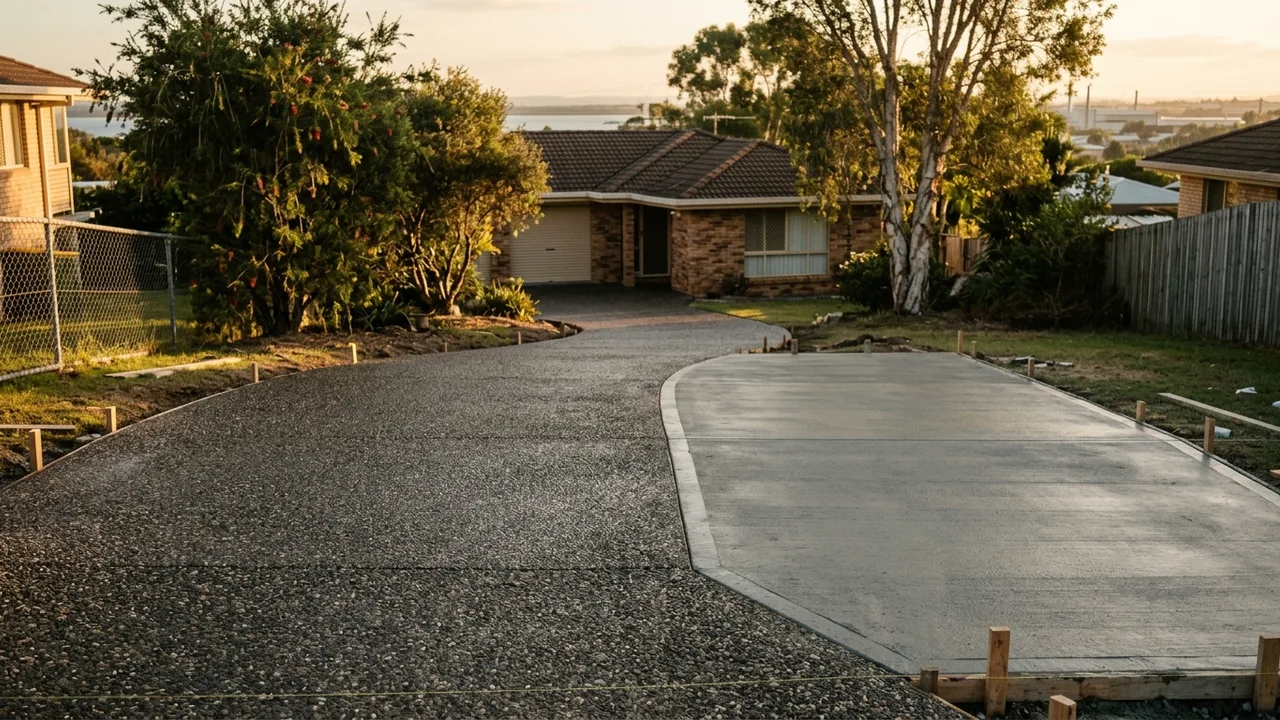
Plain concrete driveway, roughly 40 square metres:
- Initial pour: approximately $2,400 to $4,000
- Sealing every three years (DIY or tradesperson): $300 to $700 per application, so roughly $1,000 to $2,100 over ten years
- Minor crack repairs if needed: variable
Exposed aggregate driveway, same 40 square metres:
- Initial pour: approximately $3,200 to $5,200
- Sealing is still required but the surface holds up better between applications; budget $800 to $1,600 over ten years
- Lower likelihood of surface deterioration needing repair
Over ten years, the gap narrows. Exposed aggregate costs more on day one, but the maintenance burden is genuinely lighter. That's not a sales line; it's how the materials behave.
Colour, Aggregate Choice, and Kerb Appeal
One underrated factor, particularly in older Bayside streets where Queenslander-style homes still dominate, is how the driveway finish reads from the street.
Exposed aggregate gives you a degree of choice. The aggregate itself sets the palette: pale river gravels read soft and warm, charcoal or grey granite reads modern, and local sandstone aggregate can complement older brick or timber homes. You're not locked into one look.
Plain concrete in its natural state is a neutral grey. That's fine, but it can look institutional next to a painted Queenslander or a rendered cottage front. Integral colour oxide can be added to the mix, which broadens the options considerably and improves kerb appeal without going full decorative aggregate. Colour-oxide plain concrete typically costs slightly more than standard grey but less than full exposed aggregate.
If your home is in a character overlay area (some parts of Wynnum and Manly have heritage or character provisions), it's worth checking with Brisbane City Council before you commit to either finish, particularly for front driveways.
Making the Call for Your Property
Here's a straightforward way to think through it.
Choose exposed aggregate if:
- Your driveway or patio is in a salt-air-exposed position (front of the block, facing east or north-east)
- You want lower ongoing maintenance
- Slip resistance matters (sloped drive, poolside path, stairs)
- You're spending on a visible entertaining area where appearance counts
- Your budget can absorb a higher upfront cost
Choose plain concrete if:
- The slab is hidden from view (shed, garage, rear path)
- Budget is the primary constraint and you'll commit to regular sealing
- You prefer a clean, smooth aesthetic for a contemporary home
- You're doing a smaller repair or extension where matching an existing surface matters more than finish type
For most Bayside homes with a street-facing driveway or a front entertaining area, exposed aggregate earns its higher price over time. For behind-the-house slabs and purely functional jobs, plain concrete is the sensible answer.
If you're weighing up a specific project in Hemmant, Wynnum, Manly, or surrounding suburbs, it's worth having a local concreter look at your block. Slope, drainage, soil type, and existing concrete all affect what finish will perform best on your property. A quick site visit usually clears up the question faster than any article can.
Quick answers