Concreting guide
Exposed aggregate looks great but is it the right choice for your driveway?
Exposed aggregate is a genuinely attractive option for driveways, but it is not the right choice for every home or every budget. Whether it suits your place depends on a handful of practical factors, and this article walks through all of them honestly.
What exposed aggregate actually is
Standard brushed concrete has a smooth-ish surface because the fine cement paste is left covering the stones during finishing. Exposed aggregate concrete takes a different approach. Shortly after the slab is poured, a surface retarder is applied, and then the top layer of cement paste is washed or brushed away to reveal the stones (aggregate) beneath.
The stones themselves can be standard crushed bluestone, river pebbles, recycled glass, or decorative blends. The final look is textured, speckled, and genuinely hard to replicate with paint or stamping. That texture is also the reason it grips better underfoot than plain concrete, which matters on a sloped driveway.
The process requires timing. If the paste sets too hard before it is washed off, the result is uneven. If it is washed too early, stones come loose. That sensitivity to timing is one reason the finish demands an experienced operator, not a first-attempt DIY project.
Why it is popular in Bayside Brisbane
Bayside suburbs like Wynnum, Manly, and Hemmant sit in a salt-air environment. That matters more than people realise when choosing a driveway surface. Salt air accelerates the carbonation of plain concrete and can lift sealers more quickly than it would in an inland suburb. Exposed aggregate, when sealed properly with a quality penetrating or surface sealer, holds up well in coastal conditions because the sealer has the texture to bond to, and any minor surface degradation is far less visible on a mottled finish than on a flat grey slab.
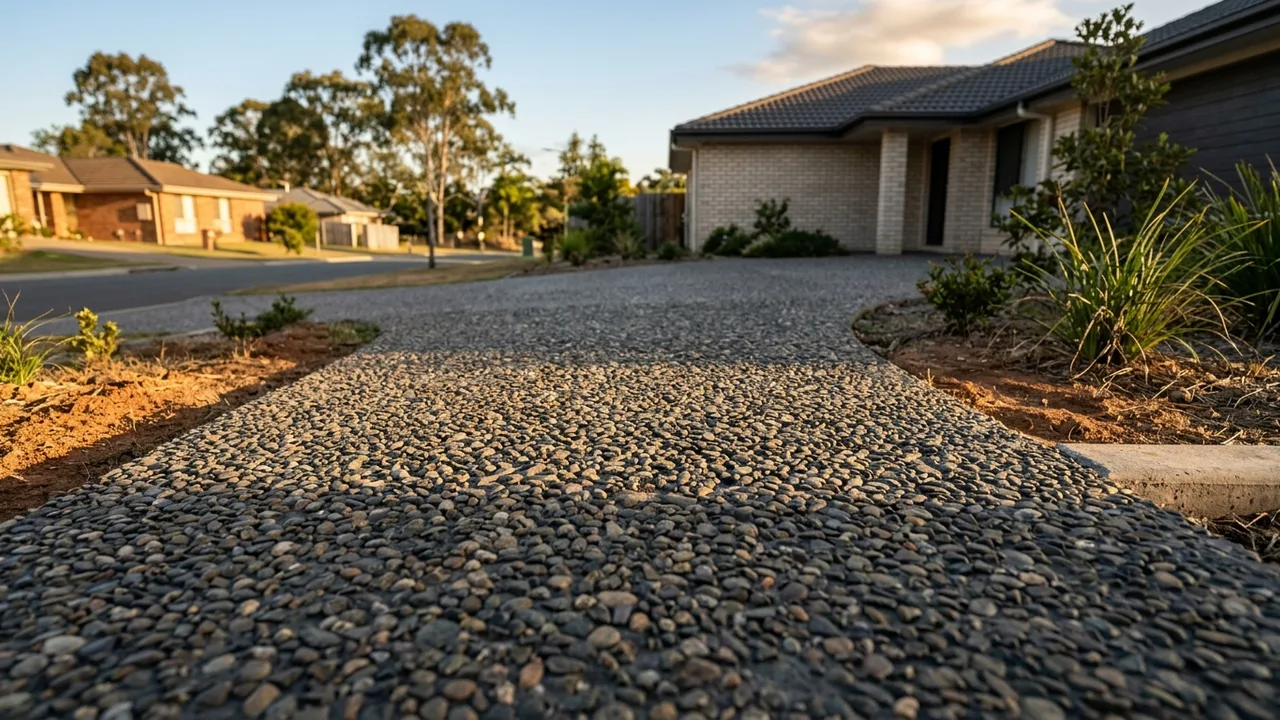
The aesthetic angle also stacks up. A lot of homes in Wynnum, Manly West, and Lota sit on blocks where the driveway is clearly visible from the street. A well-laid exposed aggregate driveway adds genuine kerb appeal without looking overdone. It reads as a deliberate design choice rather than a plain utility slab.
The honest trade-offs
No surface is perfect. Here is where exposed aggregate wins and where it falls short.
Where it wins:
- Slip resistance is noticeably better than standard steel-trowelled or even lightly brushed concrete, particularly when wet.
- The texture hides minor oil drips, tyre marks, and the kind of general surface grime that makes a plain driveway look tired within a few years.
- When a chip or crack does appear, it is far less obvious on a speckled surface.
- It holds its look well into old age if sealed regularly.
Where it falls short:
- The textured surface is harder to clean than flat concrete. A pressure washer works fine on open areas, but hosing out leaves and debris that settle between stones in a corner takes more effort.
- Resealing is not optional if you want to protect it. Typically every three to five years, depending on sun exposure and how much traffic the driveway sees. Unsealed exposed aggregate in a sunny Bayside front yard will fade and become more porous.
- It costs more than plain concrete. For a typical double driveway in the Hemmant and Wynnum corridor, exposed aggregate work tends to run $80 to $120 per square metre installed, compared to roughly $60 to $80 per square metre for plain brushed concrete. Those are rough benchmarks, not fixed quotes, and the final price depends on access, sub-base work, and the aggregate blend you choose.
- It cannot be patched invisibly. If a section is damaged years later, matching the original aggregate blend and wash depth is difficult. You can repair it, but a perfect colour and texture match is unlikely.
Comparing it to the alternatives
If you are weighing up exposed aggregate against other surfaces, here is how it stacks up practically.
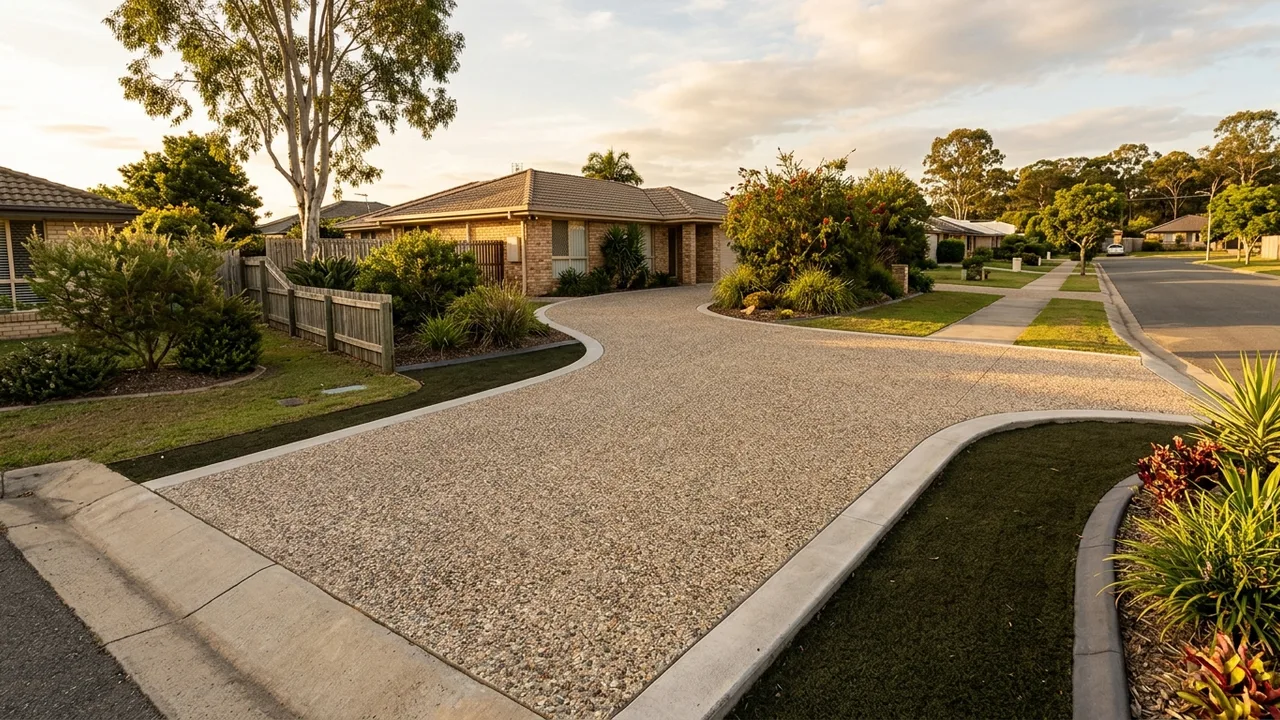
Plain brushed concrete costs less upfront and is easier to resurface later if it wears. It shows stains and cracks more readily. For a purely functional driveway with no street visibility, it is a sensible choice.
Stencilled or coloured concrete gives you pattern without the texture. It looks sharp when new but the stencil lines can wear or chip and the result can look dated. Exposed aggregate tends to age more gracefully.
Pavers are the main alternative worth taking seriously. A good clay or concrete paver driveway costs more than exposed aggregate, often $150 per square metre or above. Individual pavers can be lifted and relaid if the sub-base settles, which is a real advantage in parts of Brisbane where reactive clay soils cause movement. The downside is that weeds find their way into joints over time, and the overall surface is not as smooth to drive on. If soil movement is a known issue on your block, pavers are worth considering seriously.
Resurfacing existing concrete with an exposed aggregate overlay is an option if the existing slab is structurally sound. It costs less than a full pour, but the bond layer is thinner, and in high-traffic driveway conditions it typically does not last as long as a full-depth pour. Useful for paths and entertaining areas; less ideal as a long-term driveway solution.
What makes or breaks the result
The aggregate blend matters, but not as much as the installation conditions. A few things that genuinely affect whether you end up with a great result or a regrettable one:
- Sub-base preparation. A poorly prepared base leads to cracking regardless of how good the finish looks. In Bayside Brisbane, where some blocks have sandy or fill soil close to the surface, getting the compaction right is critical.
- Curing conditions. Hot, windy days in January or February can cause the surface to set unevenly. Experienced concreters know to adjust the mix or the timing, or to avoid those conditions altogether.
- Sealing before use. The slab needs to cure fully (typically 28 days for full strength, though most people drive on it after three to seven days at reduced load) and then be sealed before heavy use. Skipping the first seal is a common regret.
- Who does the work. The wash-off step requires someone who has done it many times. Ask your concreter how many exposed aggregate driveways they have completed and whether they can show you local examples.
So, is it the right choice for your driveway?
If your driveway is visible from the street, if you want something that holds up well in a salt-air Bayside environment, if you are willing to reseal it every few years, and if the extra cost fits your budget, then yes, exposed aggregate is a very strong choice. It is not a maintenance-free surface, but no driveway surface is.
If budget is tight, if the driveway is tucked away at the back of the block, or if you are planning to sell within a year or two and want to spend the minimum, plain brushed concrete does the job well and costs noticeably less.
The decision is not dramatic. Both surfaces last decades when laid properly. The question is whether the aesthetic and the grip benefits are worth the additional cost to you specifically, given your block and your plans.
If you want to talk through options for your place in Hemmant, Wynnum, Manly, or the surrounding suburbs, we can connect you with a local concreter who works this area regularly and can give you a straight quote on both options side by side.
Quick answers