Concreting guide
Can a capable DIYer pour their own concrete driveway in Brisbane?
Can a Capable DIYer Pour Their Own Concrete Driveway in Brisbane?
Yes, technically you can. A capable DIYer with the right tools, enough helpers, and a realistic understanding of what's involved can pour a small to medium concrete driveway. But "capable" is doing a lot of heavy lifting in that question, and Brisbane's climate adds a few complications that can turn a manageable job into an expensive mistake if you underestimate them.
Here's what you actually need to know before you decide.
What the Job Actually Involves
Pouring concrete looks deceptively simple from the street. In practice, a standard residential driveway involves:
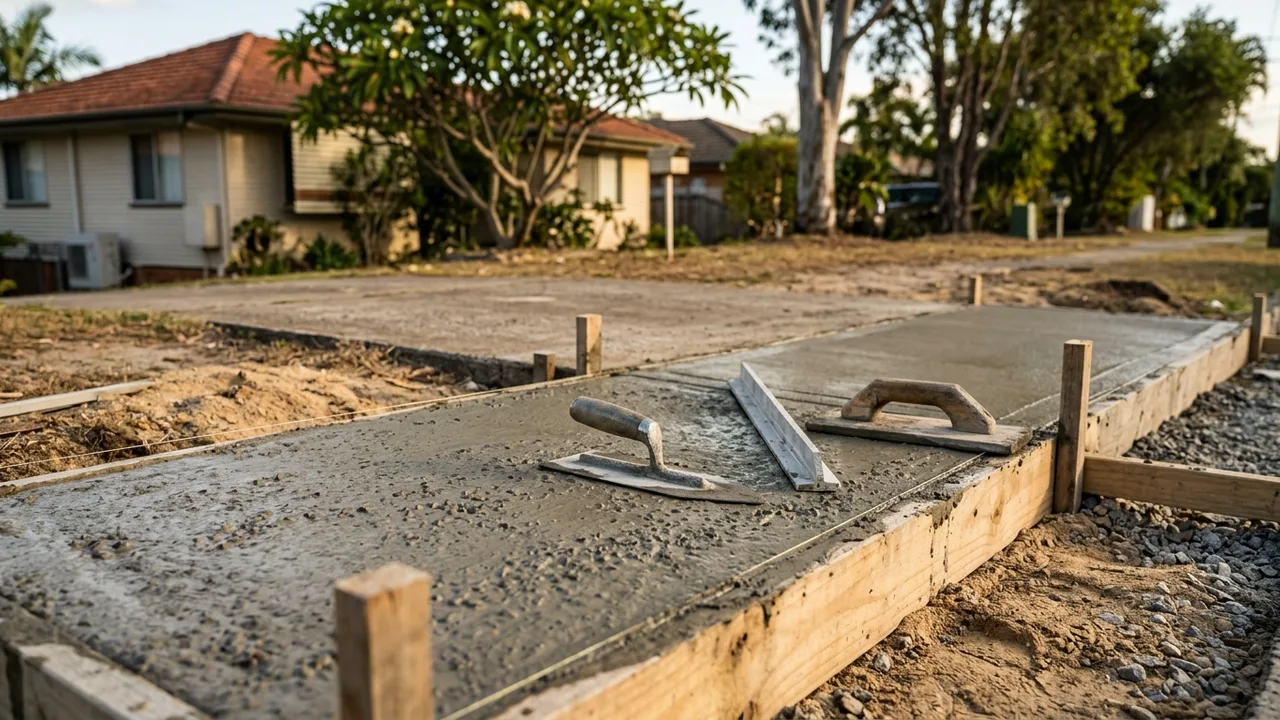
- Site preparation: stripping topsoil, compacting the sub-base, checking for fall and drainage
- Formwork: setting timber or steel forms to the correct height and line
- Steel reinforcement: laying mesh (typically SL72 or SL82 for a driveway) and positioning it off the ground with bar chairs
- Ordering and receiving a ready-mix truck: coordinating pour timing, truck access, and chute reach
- Placing and screeding: spreading the concrete quickly and evenly before it sets
- Finishing: floating and trowelling to a consistent surface
- Control joints: cutting or tooling joints to control where cracking occurs
- Curing: keeping the slab moist and protected for at least seven days
Each of those steps has its own skill level and its own failure mode. Missing one or rushing one can compromise the whole slab.
A typical single-car driveway in the Bayside area (Hemmant, Wynnum, Manly and surrounds) runs roughly 30 to 45 square metres. At a minimum 100 mm thickness with a decent sub-base, you're looking at somewhere between 3.5 and 5.5 cubic metres of concrete. That's not a barrow-mix job. You will need a ready-mix truck.
Brisbane's Climate Makes Timing Critical
This is the detail that catches a lot of DIYers out. Concrete doesn't care about your weekend plans. It cares about temperature, humidity, and wind.
In Brisbane, particularly through summer (November to March), you're often working in conditions that accelerate surface drying. Hot ambient temperatures, low humidity on certain days, and even a light breeze can cause the surface to dry faster than the concrete below it is setting. The result is plastic shrinkage cracking, and once it's there, you cannot finish it away.
The practical fix is to pour early in the morning, use a retarder if your concrete supplier recommends one, have enough people on site to keep pace with the pour, and avoid pouring on days above about 32°C if you can help it.
The bayside suburbs (Wynnum, Manly, Lota) do get afternoon sea breezes off Moreton Bay. That sounds pleasant but it is a real drying risk for fresh concrete. Inland Hemmant and Wynnum West tend to be a few degrees hotter and less breezy, which has its own challenges. Either way, check the Bureau of Meteorology forecast the day before and be prepared to postpone.
Tools and Helpers: What You Actually Need
This is where the honest answer gets uncomfortable. Properly equipping a DIY concrete driveway pour is not cheap, and much of what you need you probably don't own.
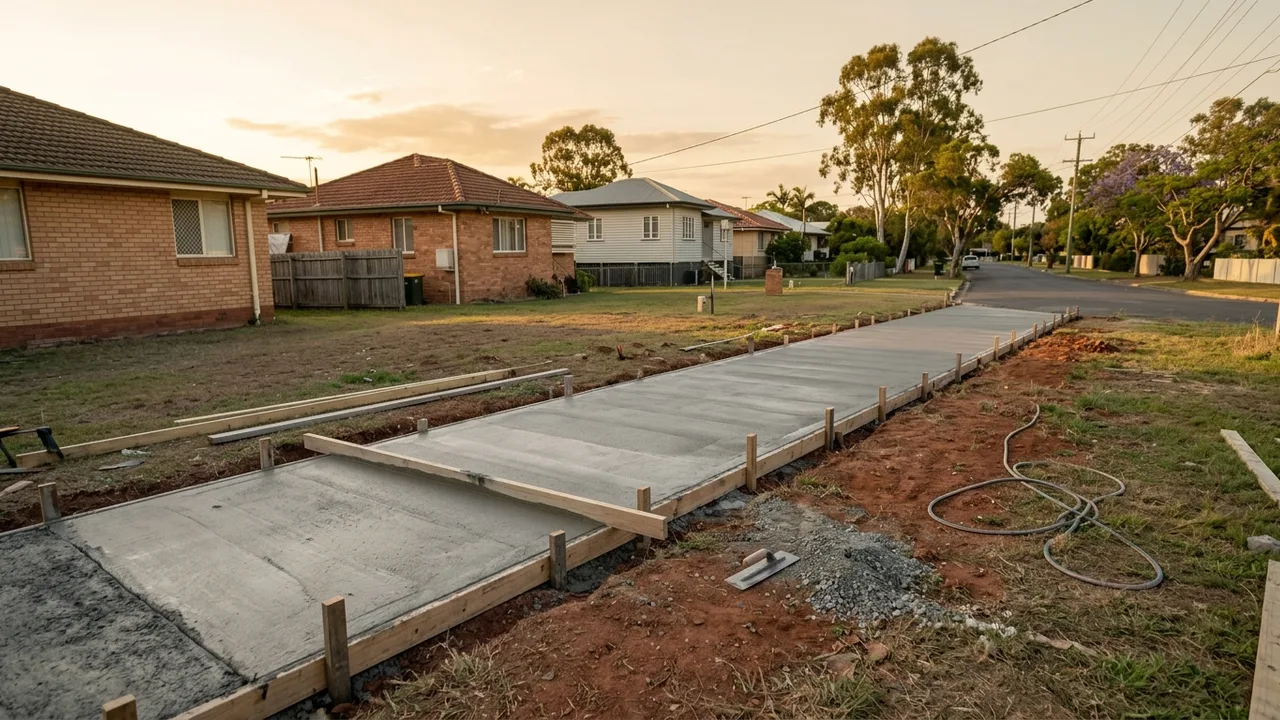
At minimum you'll need:
- A screed board (a long straight edge, 2 to 3 metres)
- A bull float (a wide, long-handled float for initial finishing)
- A magnesium hand float and steel trowel
- A concrete groover or saw for control joints
- A vibrator or screed vibrator to consolidate the mix around the reinforcement
- Formwork timber and stakes
- A plate compactor for the sub-base (typically hired)
- Eye protection, gloves, and rubber boots (concrete is caustic)
Hire costs for a compactor and vibrator alone can add $150 to $300 to your budget for a weekend. That's before materials.
You also need people. Two is workable for a small pour; three or four is better. Concrete doesn't pause while you catch your breath, and if the truck is running and you fall behind, you have a problem.
The Real Cost Comparison
The honest reason most people consider DIY is to save money. That's a fair reason. So let's look at it clearly.
A professional concreter in the Bayside Brisbane area typically charges somewhere in the range of $65 to $110 per square metre for a standard broom-finished driveway, depending on thickness, reinforcement, site access, and prep work. For a 40 m² driveway, that puts the professional quote roughly in the $2,600 to $4,400 range in most cases.
DIY concrete material costs (mesh, formwork, concrete, stakes, plastic sheeting, curing compound) for the same area might land between $1,200 and $2,000 depending on your concrete supplier's pricing and whether you need any sub-base material delivered.
So the raw saving could be $1,000 to $2,500. That's real money. But factor in:
- Tool and equipment hire
- Your time (typically a full weekend for prep and pour, plus curing checks)
- The cost of a poor finish or premature cracking if something goes wrong
- The fact that a professionally poured driveway is generally expected to last 25 to 40 years with basic maintenance
If the slab cracks badly in year two because the sub-base wasn't compacted properly or the control joints were in the wrong spots, you've saved nothing. Concrete resurfacing can patch some problems, but a structurally compromised slab often needs breaking out and replacing.
Where DIY Makes Sense (and Where It Doesn't)
DIY is most reasonable when:
- The driveway is simple in shape (straight, rectangular, no curves or complex falls)
- You have a genuinely capable and experienced team helping you
- You've done formwork or similar concreting before, even on a smaller scale
- The sub-base is already solid (some Brisbane properties have a firm clay base that needs minimal prep)
- You're not trying to achieve a decorative finish like exposed aggregate or a pattern stamp
DIY becomes a bad idea when:
- The driveway has a significant slope, a curve, or drains through a channel
- You want a decorative finish (exposed aggregate, in particular, requires timing and technique that's very hard to get right without experience)
- The site has poor drainage or reactive clay soils, which are not uncommon in parts of Hemmant and Wynnum West
- You're working to a council approval that requires certified construction
It's worth noting that Brisbane City Council doesn't typically require a permit for a standard residential driveway replacement, but a new driveway crossing (connecting to the kerb) usually does require a council-approved crossover application. Check with council before you start.
A Practical Recommendation
If you've poured concrete before (even a path or a small slab), you understand curing, you have three or four solid helpers, and the job is a straightforward rectangular pour under 40 square metres, then DIY is a reasonable option to seriously consider. The saving is meaningful and the job is achievable.
If you're new to concrete work, if the driveway has any complexity, or if you're in a bayside suburb with the added wind and salt-air variables to manage, the risk of a poor outcome goes up significantly. In that case, getting a quote from a local concreter isn't admitting defeat. It's just sensible maths.
A properly quoted professional job for a 30 to 45 m² driveway in the Hemmant, Wynnum, or Manly area typically sits somewhere between $2,000 and $5,000 depending on specifications, and you get a finished product with a warranty behind it.
Either way, go in with your eyes open about the time, the tools, and the weather. Concrete is unforgiving of wishful thinking.
Quick answers