Concreting guide
What actually determines the cost of a concreting job in Hemmant?
What actually determines the cost of a concreting job in Hemmant?
The short answer: square metres, concrete thickness, finish type, and site access. Those four factors do the heavy lifting. Everything else, including soil conditions, reinforcement, formwork complexity and the time of year you book, sits on top of them.
If you want a ballpark before you call anyone, a basic broom-finished concrete driveway in Hemmant typically runs somewhere between $65 and $110 per square metre, all in. A decorative exposed aggregate finish will push that higher. A simple garden path will come in lower. The range across the whole job spectrum, from a small repair to a full driveway replacement, is roughly $1,500 to $15,000 for residential work in this area. Here is what moves the number up or down.
Square metres and slab thickness
These two variables are inseparable. A concreter prices by the cubic metre of concrete poured, so area multiplied by depth is the foundation of every quote.
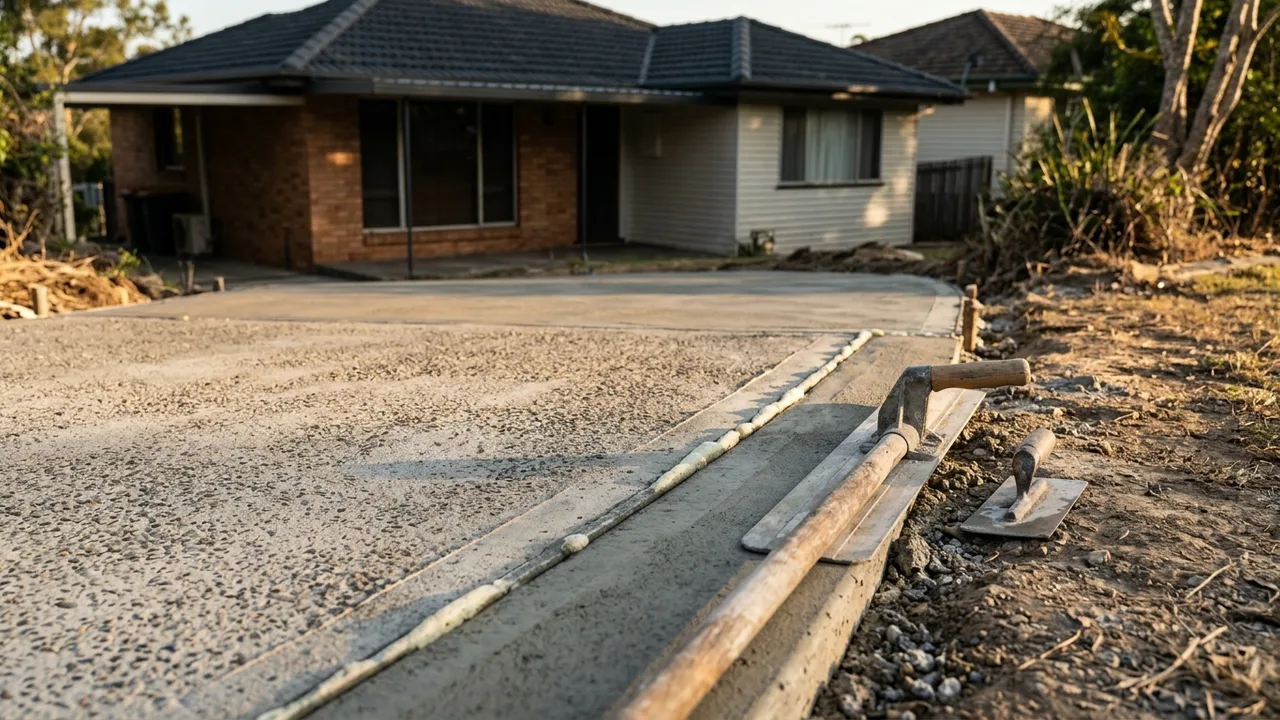
For a standard residential driveway, 100mm is typical. Shed and garage slabs that will carry a vehicle usually call for 100-125mm with appropriate reinforcement. A pedestrian pathway can often work at 75-85mm. Go thinner to save money and you are trading long-term durability; in Hemmant's clay-heavy soil conditions, undersized slabs can crack faster than they should.
A double-width driveway (around 54-60 m²) at 100mm will use noticeably more concrete than a single (around 27-30 m²). That sounds obvious, but people often forget that batch charges and truck minimums mean the per-metre cost of a small pour can be disproportionately high. If you are pouring a 10 m² garden path, you may be paying for a larger batch than you actually need. Combining jobs, say, a path and a small landing poured on the same day, can help keep unit costs sensible.
Ground conditions and preparation work
This is where Hemmant and the surrounding Bayside suburbs can bite you. Much of the land between Wynnum and Hemmant sits on reactive clay. Reactive clay shrinks in dry weather and swells after rain. That ground movement is one of the main reasons concrete cracks, and it is why your site preparation matters as much as the concrete mix itself.
A reputable concreter will excavate the area, compact a sub-base (typically road base or crushed rock), and check levels before they pour. If your site has poor drainage or you are on a lower-lying block, they may need to build up the sub-base further or install drainage before laying formwork. That adds cost but it also protects the slab.
For properties in Wynnum West or the lower parts of Hemmant that sit closer to the bay or tidal flats, some blocks can have fill soil of variable quality. If the ground has not been properly consolidated, you may need additional engineering advice before a large pour. Not every job needs this, but it is worth asking the question.
Removing and disposing of existing concrete is another cost people underestimate. Breaking up an old driveway, loading it and tipping it at a waste facility adds roughly $30 to $60 per square metre on top of the new slab price, depending on slab thickness and how hard the concrete is to break.
Finish type and decorative options
The finish you choose has a real impact on the final price.
- Broom finish is the most common and most affordable. It gives a slightly textured surface that hides minor imperfections and provides grip underfoot. It is the practical default for driveways and utility slabs.
- Exposed aggregate costs more, typically $100 to $160 per square metre in this area, because it requires a specific concrete mix with selected aggregate, a surface retarder applied before the concrete sets, and a pressure wash to expose the stones. The result is attractive and durable, which is why it is popular for the street-facing driveways of homes in Manly and Wynnum.
- Coloured or stencilled concrete adds further cost and a skilled hand. A decorative patio for an alfresco area in Lota or Manly West can look excellent with a coloured finish, but budget accordingly.
For purely functional work, a broom finish delivers the best cost-to-life ratio. For kerb appeal or entertaining areas, the step up to exposed aggregate often makes sense.
Reinforcement, formwork and complexity
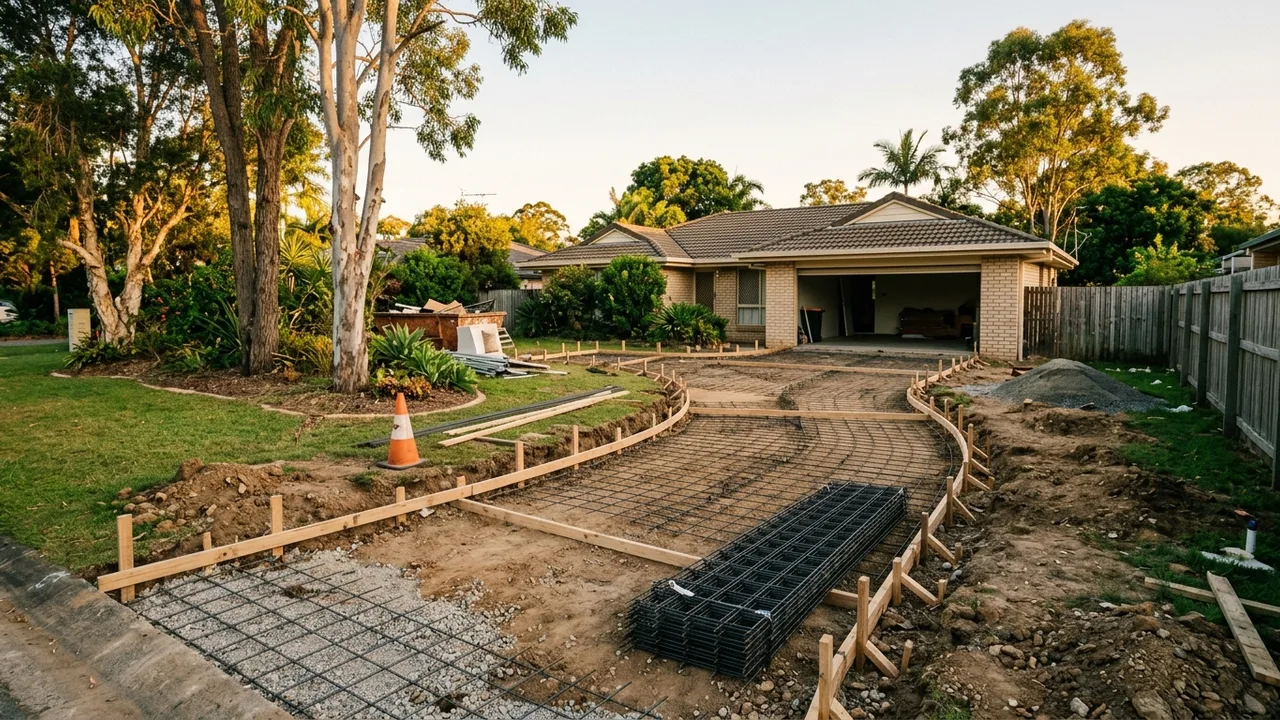
Reinforcement is not optional for most structural pours. A driveway that carries a car needs steel mesh (SL72 or SL82 mesh is common) or steel bar, depending on the engineering. Shed slabs often require a thickened edge beam as well. That steel, plus the time to cut and position it, adds to your quote.
Formwork, the timber or steel boxing that holds the wet concrete in shape, costs more when your site is irregular. A straightforward rectangular driveway is cheap to form. A curved driveway, a patio with multiple levels, or a slab that steps around a garden bed takes longer to set up and therefore costs more in labour.
Slopes add complexity too. If your block in Hemmant or Wynnum has a fall, the concreter needs to account for that in the formwork and potentially in a retaining element at the lower edge. A poured concrete retaining wall alongside a driveway is a common combination on sloping Bayside blocks, and pricing these as a single project is often more economical than treating them separately.
Access, timing and regional factors
Access matters more than most people realise. If a concrete truck cannot get within a reasonable distance of your pour, the concreter may need to pump the concrete from the road to the site. A concrete pump typically adds $500 to $900 to the job, sometimes more for longer runs. Properties with narrow side gates, steep driveways or overhanging trees can all create access issues worth flagging upfront.
The Bayside location is a modest factor for material specification. Properties within the immediate salt-air zone near Wynnum beach or Manly boat harbour may benefit from a slightly higher-grade concrete mix to resist corrosion around reinforcement. Most concreters working in this area factor that in as standard, but it is worth confirming.
Seasonal timing has a smaller effect than many expect. Summer heat affects the curing process and can cause surface cracking if the slab dries too quickly; a good concreter will wet-cure or use a curing compound to manage this. There is typically no formal price difference between summer and winter bookings, but demand peaks in spring and autumn, so lead times can stretch.
How to use this information when getting quotes
Get at least two quotes, ideally three, from concreters who have done work in the area. Ask each one to itemise the quote so you can see what they are charging for sub-base preparation, concrete supply, reinforcement, formwork and finishing separately. That makes comparisons meaningful.
If one quote is significantly lower than the others, ask whether the preparation work is included or whether it assumes your ground is already level and compacted. That omission is one of the most common sources of "surprise" charges mid-job.
You do not need to know everything about concrete to make a good decision. You just need enough to ask the right questions. A straightforward Hemmant driveway, broom finished, single width, no removal of old concrete, on reasonably flat ground with good access, should be quoted and delivered without drama. Once you add removal, poor soil, a decorative finish or a difficult access, the price moves for legitimate reasons.
If you want to be connected with a local concreter who is familiar with Bayside soil and site conditions, that is what this service is here for. A quick call or message is enough to get the process started.
Quick answers