Concreting guide
Steel mesh versus reo bar: which reinforcement does your slab actually need?
The short answer first
For most residential concrete slabs in the Bayside Brisbane area, SL62 or SL72 steel mesh handles the job fine. Reo bar (reinforcing bar, or "rebar") is the better choice when loads are heavier, spans are longer, or the ground beneath the slab is unreliable. The decision mostly comes down to what the slab has to carry and what it's sitting on.
That said, the nuance matters. Choosing the wrong reinforcement does not just waste money; it can produce a slab that cracks badly or fails to meet engineer specifications for an insurer or council. Here is how to think it through properly.
What reinforcement actually does in a concrete slab
Concrete is strong in compression — push down on it and it resists well. It is weak in tension — try to bend or pull it apart and it cracks. Reinforcement carries that tension load so the slab stays in one piece when it flexes under weight or when the ground moves beneath it.
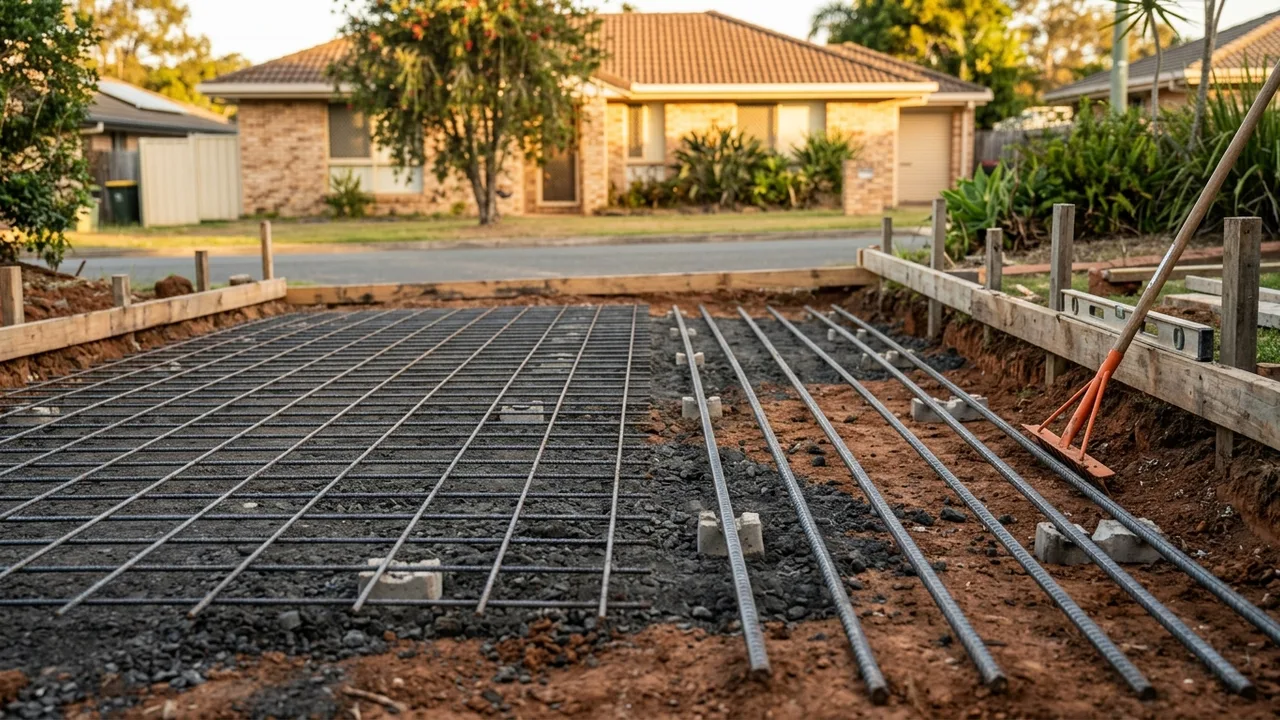
In Brisbane's Bayside suburbs (Hemmant, Wynnum, Manly, Lota and surrounds), the soil story matters a lot here. Much of this area sits on reactive clay. Reactive clay shrinks when it dries out and swells when it gets wet. That movement puts ongoing bending stress into any slab poured over it. Reinforcement is not optional in that environment; the question is just which type suits the job.
What steel mesh is, and where it works well
Steel mesh (also called "trench mesh" in narrow strips, or "sheet mesh" for full slabs) is a pre-welded grid of steel wire. Common residential grades are SL62, SL72, SL82 and SL92. The number refers to wire diameter and spacing. SL72, for instance, uses 7mm wire at 200mm centres in both directions.
Mesh is factory-made, so placement on site is relatively quick. Sheets or rolls are laid into the slab before the pour, held up on bar chairs so the steel ends up roughly in the middle or lower third of the slab thickness.
Mesh suits these situations well:
- Residential footpaths and garden paths (typically 75-100mm thick)
- Driveways with normal passenger vehicle traffic
- Alfresco and entertaining area slabs with standard outdoor furniture and foot traffic
- Shed slabs where no heavy plant or vehicle is stored
For a standard 100mm domestic driveway in Wynnum or Manly West, SL72 mesh in a single layer is a common and reasonable specification. It is cost-effective, quick to lay, and adequate for the loads involved.
What reo bar is, and where it pulls ahead
Reo bar is individual steel rod, supplied in straight lengths or coils, and cut and bent on site to form a grid or specific shapes. Common residential diameters run from N10 (10mm) to N16 (16mm). Unlike mesh, reo bar can be placed at varying spacings and depths, bent around curves, and configured to handle forces coming from a specific direction.
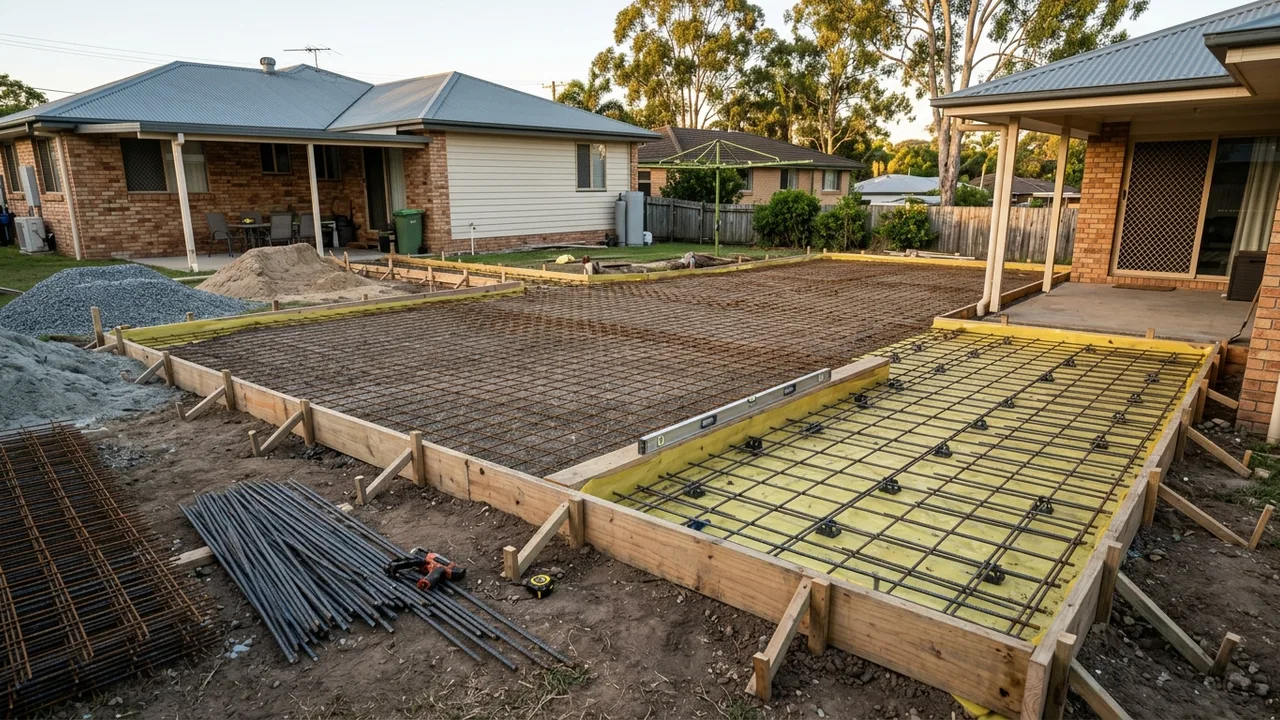
That flexibility is the point. An engineer can specify exactly where the steel goes, how much of it, and in which layers.
Reo bar tends to be specified when:
- The slab is thicker than 150mm
- The slab has to carry a concrete garage with a vehicle heavier than a standard car (a ute, a boat trailer, a loaded tradesman's van)
- There is a long unsupported span, for example a slab bridging over a service trench or a suspended slab above a void
- The site has poor or variable fill, or documented expansive soil that triggers an engineer's assessment
- Council or an insurance requirement specifically calls for an engineered design
- The slab is a footing slab with edge beams, common for larger shed slabs in Hemmant and the surrounding bayside area
Reo bar costs more in labour because it is cut, bent and tied by hand on site. For a 6m x 6m shed slab, the difference in material cost is modest, but labour adds up. Expect reo bar installation to take noticeably longer than dropping in mesh sheets.
The cost and practical trade-offs
Here is an honest comparison for a typical residential job:
Mesh (SL72, single layer, 100mm slab):
- Faster to lay, less skilled labour required for placement
- Lower labour cost per square metre
- Adequate for most driveways, paths, and alfresco areas
- Less flexible if the design changes on the day
- Does not handle point loads (like a jack stand or a heavy machine leg) as well as a heavier bar configuration
Reo bar (N12 at 200mm centres, 150mm slab):
- Higher labour cost
- Better suited to heavy or concentrated loads
- Can be customised to engineer's drawings
- Slower pour day because more prep is involved
- Necessary for council-approved structures in some situations
For jobs in the $1,500 to $15,000 range common in Bayside residential work, the cost difference for reinforcement alone is often only a few hundred dollars. The bigger cost driver is usually slab thickness and concrete volume, not the steel itself. Choosing reo bar when mesh would have been fine is not a catastrophic error; you just pay a bit more. Choosing mesh when reo bar was needed is riskier because fixing a cracked or failed slab typically costs more than doing it right the first time.
How soil conditions in Bayside Brisbane shape the choice
The Bayside corridor from Hemmant out to Wynnum, Manly and Lota has a mix of soil profiles. Near the bay and the creek systems there is often fill over reclaimed or low-lying ground. Older residential blocks in Wynnum West can have made-up fill from past earthworks. Properties closer to the higher ground in Manly or Lota tend to sit on more stable clay-rich profiles, but that clay still moves seasonally.
If a soil report (a geotechnical assessment) has been done for a building project, the reinforcement specification typically comes from that. For smaller jobs like a backyard shed slab or a driveway replacement, a formal soil test is rarely done. Instead, an experienced local concretor uses judgement based on what they can observe: soft spots in the sub-base, evidence of past movement, drainage patterns, and how the neighbours' slabs have fared.
In coastal areas, reinforcement cover (the thickness of concrete over the steel) also matters for corrosion. The salt air in Wynnum and Manly is not as aggressive as open ocean exposure, but it is real. A minimum of 40mm cover over reinforcement is a reasonable standard for exterior slabs in this zone, and some concretors go to 50mm on exposed coastal sites. This affects slab thickness decisions indirectly.
When you genuinely need an engineer to decide
For most driveways, paths, and simple shed slabs, a qualified and experienced concretor can make the reinforcement call confidently without a separate engineer. That is normal practice.
You should involve a structural or civil engineer when:
- A council development approval (DA) or building approval is required and the approval conditions request an engineering certificate
- The slab is part of a structure with walls or a roof (the loads change significantly)
- There is a documented history of subsidence or movement on the site
- The slab spans over a void, stormwater pipe, or service trench
- The finished slab will carry anything heavier than a standard vehicle on a regular basis, such as a boat storage slab or a workshop with a hoist
Engineering fees for a residential slab specification in Brisbane are typically in the range of $300 to $800. That is a small outlay relative to the total job cost, and it transfers responsibility for the specification to a licensed professional.
A closing recommendation
If you are planning a driveway, alfresco pad, or straightforward shed slab in Hemmant, Wynnum, Manly or anywhere in the Bayside cluster, start by asking your concretor specifically what they are specifying and why. A good operator will tell you the mesh grade, the slab thickness, and whether they see anything about your site that warrants upgrading to reo bar.
You do not need to become an expert. But you do deserve a straight answer about what is going in the ground under your concrete. If the quote just says "reinforced concrete slab" without any detail, ask the follow-up question. That conversation will tell you a lot about who you are dealing with.
If you would like to talk through what is right for your specific job with a local concretor who works in this area, we can help with that connection.
Quick answers