Concreting guide
How thick does a residential concrete driveway actually need to be?
The Short Answer: 100 mm for Most Brisbane Homes
For a standard residential driveway that carries passenger cars, a finished thickness of 100 mm (10 cm) is the broadly accepted minimum in Australia. If your driveway needs to handle a light commercial vehicle, a boat trailer, or a heavy ute that gets parked there regularly, 125 mm to 150 mm is the more sensible target. That's the answer upfront. Everything below explains why those numbers exist and how your specific property can shift them.
Why Thickness Matters More Than You Might Think
Concrete doesn't just sit on the ground. It spans across the soil beneath it, distributing load the way a bridge distributes traffic. When the slab is too thin, the concrete flexes under load. Concrete handles compression well but copes poorly with flex. Enough flexing and you get cracks, not surface crazing but structural cracking that lets water in, which in Brisbane's summer downpours is a fast track to spalling and subsidence.
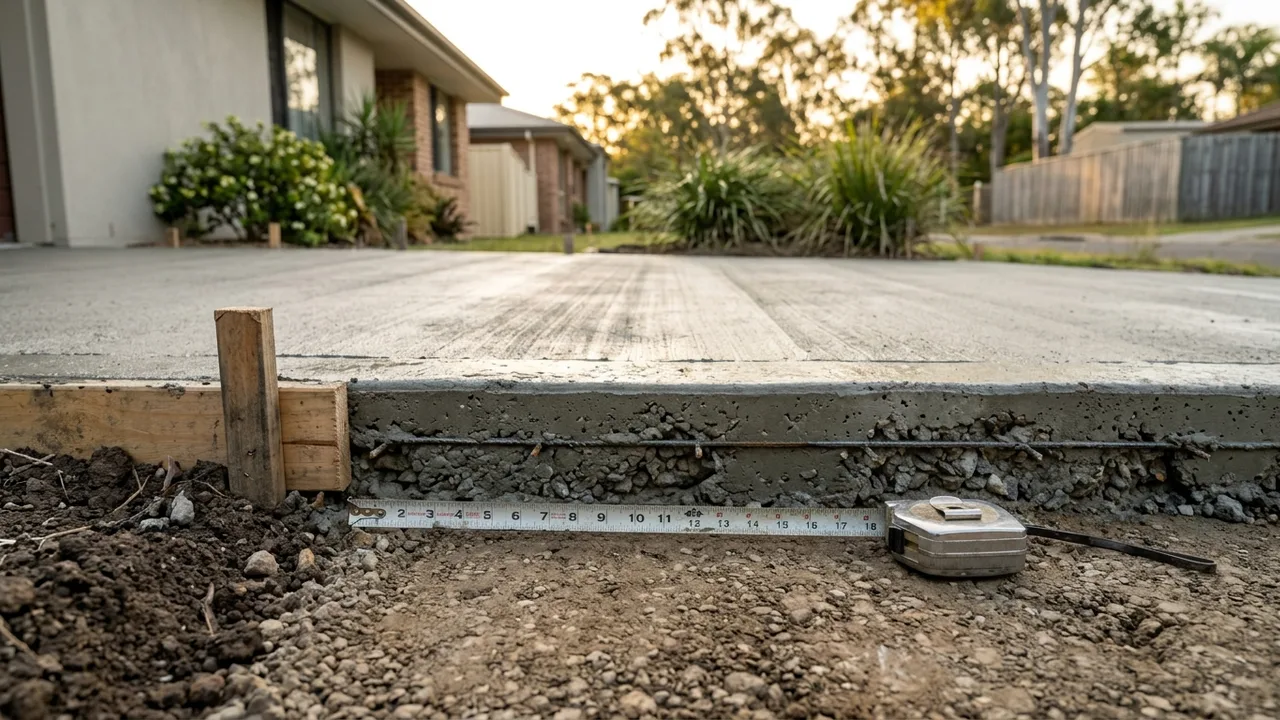
A slab that's too thin can also fail quietly. The surface looks fine for a year or two, then a heavy skip bin gets placed on it or a removalist truck rolls a corner wheel over the edge, and the concrete fractures. Replacing a driveway costs considerably more than getting the thickness right the first time, typically $3,000 to $9,000 for a full replacement in the Hemmant and Bayside area depending on size and finish.
Thickness is only one part of the equation. Subgrade preparation, concrete strength (measured in MPa), reinforcement, and joint placement all interact with thickness. But thickness is the one variable homeowners most often ask about and tradies most often cut corners on, so it's worth understanding properly.
The Australian Standard Baseline (and What It Actually Says)
AS 3727-1993 is the Australian Standard that covers residential concrete flatwork. It nominates 100 mm as the minimum slab thickness for a domestic driveway subject to passenger vehicle loads. This is not a recommendation; it's a floor, the minimum below which a competent concreter should not go.
In practice, many experienced concreters in Brisbane pour at 100 mm for a typical single or double driveway and achieve perfectly durable results, provided the subgrade is solid and the concrete mix reaches at least 25 MPa strength. Some specify 32 MPa as a default because the marginal cost increase is small and the durability gain is real.
Worth noting: AS 3727 is a standard for guidance, not a mandatory building code requirement for a residential slab in Queensland. Your local council doesn't typically inspect a driveway slab the way it inspects a structural element. That means the standard is enforced by the quality of the contractor you use, not a building inspector. It's on you to ask the right questions.
How Brisbane's Soil Conditions Change the Calculation
Brisbane is built on a patchwork of soil types, and this matters. Much of the inner western suburbs sit on reactive clay, the kind that swells when wet and shrinks when dry. Bayside suburbs like Hemmant, Wynnum, and Manly sit on a different profile, often sandier fill near reclaimed or low-lying land, transitioning to clay and rock further from the water.
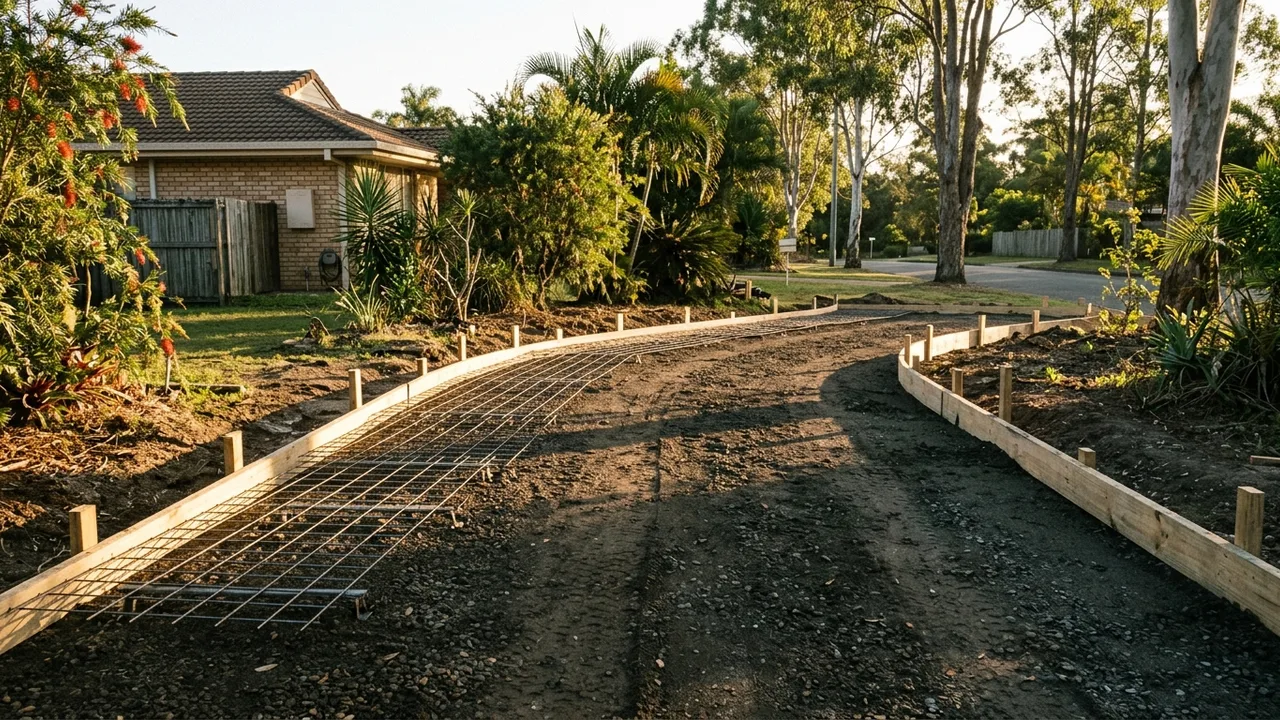
Reactive clay is the main concern for driveways. When the soil beneath a slab moves seasonally, a thinner slab is more likely to crack. On a reactive clay subgrade, some concreters recommend stepping up to 125 mm and adding reinforcement (typically F72 or F82 steel mesh) as standard practice, not just as an upsell. On a well-compacted granular subgrade, 100 mm with mesh is usually sufficient.
In the bayside cluster specifically, Hemmant and Wynnum West properties on reclaimed or low-lying land can have subgrades that require additional preparation before the concrete even goes down. Proper compaction of a crushed rock or road base layer (typically 100 mm of compacted base) is as important as the slab thickness itself. A thick slab on a poorly prepared base will still crack.
If your block has notable slope, which is common in Manly and parts of Lota, you may also be looking at a driveway that incorporates a retaining edge or is poured in sections. Each section should still meet the 100 mm minimum, and thickened edges (a thickened perimeter beam poured monolithically with the slab) are commonly used to add resistance to edge cracking.
Reinforcement: The Partner to Thickness
Thickness alone doesn't tell the full story. Reinforcement is what holds the slab together if cracking does begin.
- Steel mesh (F72 or F82) is the standard residential option. It sits at roughly mid-depth in the slab and helps control crack propagation. F72 suits lighter-loaded driveways; F82 is heavier and used where more load or subgrade movement is expected.
- Steel fibre reinforcement is increasingly used as a supplement or alternative to mesh. It mixes through the concrete rather than sitting as a layer, offering more consistent crack resistance. Some concreters use it alongside mesh for high-load applications.
- No reinforcement at all is unfortunately still used by some operators to save cost. On a 100 mm slab over reactive soil, an unreinforced pour is a gamble. Concrete without reinforcement is brittle when the ground beneath it shifts.
If a quote you receive doesn't specify the reinforcement type, ask. It's a reasonable question and a good concreter will answer it without hesitation.
What About Heavy Vehicles and Edge Cases?
Most residential driveways only ever see passenger cars and the occasional light truck. But some properties have specific demands worth accounting for:
- Caravans and boat trailers add significant point load through the towbar jack. A 100 mm slab can handle this but thickening the area where the jack typically lands (or using a thickened pad) is a sensible precaution.
- Heavy utes and SUVs are standard passenger vehicles for AS 3727 purposes. A current-model LandCruiser or RAM 1500 parked on a 100 mm slab is fine.
- Skip bins and concrete trucks are a separate category. If a skip bin company or a concrete truck needs to drive across your driveway during construction works, a standard residential slab is not rated for that. Protect it with timber or steel sheeting, or accept that damage may occur.
- Three-car garages and wider driveways don't need extra thickness purely because of width, but wider pours need more attention to joint placement to control where cracking occurs.
A Practical Recommendation Before You Get Quotes
If you're planning a new driveway in Hemmant, Wynnum, Manly, or any of the surrounding bayside suburbs, here's a reasonable baseline to take into your conversations with concreters:
- 100 mm minimum finished thickness, poured in one consistent layer (not topped up with a thin screed over a thinner base).
- 25 MPa concrete as a minimum, with 32 MPa worth the modest premium.
- F72 or F82 mesh, positioned at mid-depth, not draped on the ground and then lifted halfway, a common shortcut.
- 100 mm of compacted road base beneath the slab, not just raked dirt.
- Control joints cut or formed at roughly 3 metre intervals to give cracking somewhere controlled to happen.
For properties with known clay movement, a boat or caravan parked regularly, or vehicles heavier than standard passenger cars, step up to 125 mm and discuss F82 mesh with your contractor.
The difference in cost between a 100 mm and 125 mm pour on a standard double driveway is typically a few hundred dollars in concrete volume. Against the cost of a replacement in five years, it's not a hard trade-off to make.
Getting a couple of quotes from local concreters who know Brisbane's soil conditions is the most useful step you can take. Ask each one specifically about slab thickness, concrete strength, and reinforcement, and see whether their answers align with what you've just read.
Quick answers