Concreting guide
What actually drives the cost of a concrete driveway in Bayside Brisbane?
What Actually Drives the Cost of a Concrete Driveway in Bayside Brisbane?
The single biggest factor is square metreage, but it's far from the only one. In Bayside Brisbane, where soil conditions, salt-laden air and the legacy of older allotments all play a role, the final price of a concrete driveway can swing by thousands of dollars for homes that look almost identical from the street. Understanding what pushes the price up or down helps you have a smarter conversation with any concreter you bring out to quote.
Size and Shape: The Starting Point for Any Quote
A standard single-car driveway runs roughly 3 metres wide and 5 to 6 metres long from the kerb to the garage. Double that width for a double driveway. As a rule of thumb, plain grey concrete in the Bayside area typically falls somewhere between $65 and $100 per square metre for supply and labour combined, though that range shifts depending on everything else covered below.
Shape matters as much as size. A straight rectangle is the cheapest form to pour because formwork is quick and waste is minimal. Curves, tapered sections or driveways that wrap around the side of the house add labour time and can add meaningfully to the price per metre. If your Wynnum or Manly home has a sweeping curved entry, factor that in early.
Ground Conditions: What's Hiding Under Your Property
Bayside Brisbane sits on a mix of soil types, and the ground under your driveway has a direct effect on cost. Parts of Hemmant, Wynnum West and areas closer to the foreshore have clay-heavy or reactive soils. When soil moves with moisture changes, it stresses the slab from below. A competent concreter will account for this.
Preparation costs include:
- Excavation depth. If the existing surface needs to be cut down further to allow for a proper sub-base, that's machine hire and disposal costs.
- Fill and compaction. Bringing in clean fill or road base to create a stable, level platform adds material and labour.
- Tree roots. Older Bayside blocks often have established trees, including native figs, poinciana and jacaranda. Roots that interfere with the sub-base need to be cleared carefully, and in some cases the presence of large roots near the driveway edge means ongoing risk that no finish will eliminate entirely. That's worth knowing before you commit.
On a typical Bayside job, site preparation can account for 20 to 30 per cent of the total cost. Skimping here is one of the more common reasons driveways crack within a few years.
Concrete Specification: Thickness, Strength and Reinforcement
Not all concrete is the same mix, and not all driveways carry the same load.
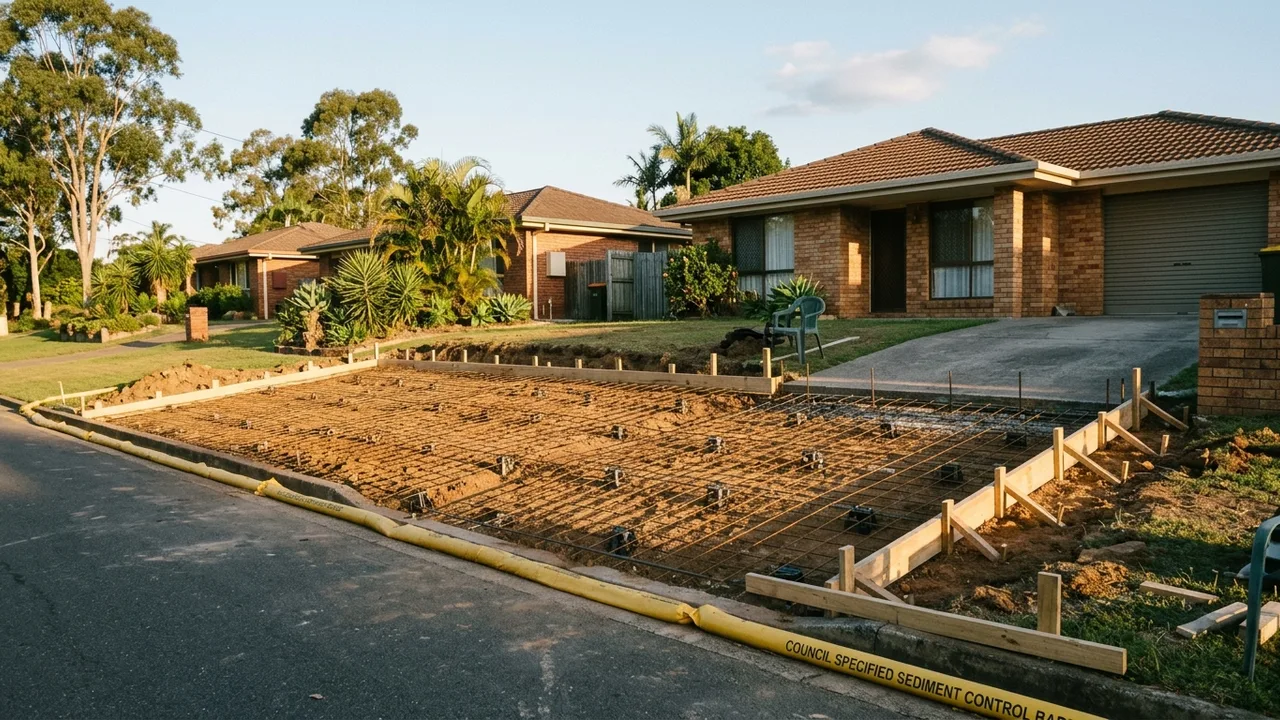
For a standard passenger-vehicle driveway, 100 millimetres of concrete at 25 MPa strength is a common baseline. If you're parking a heavy vehicle, a caravan or a boat trailer, stepping up to 125 mm at 32 MPa is worth discussing with your concreter. The material cost difference is real but relatively modest compared to the cost of repouring a slab that fails under load.
Reinforcement is the other variable. Steel mesh (SL72 or SL82 grid) is standard in most residential driveways across the Bayside cluster. Some concreters offer polypropylene fibre added to the mix as a supplement or alternative. Fibres help resist surface cracking but don't replace structural mesh where the ground is reactive or the load is significant. This is a trade-off worth discussing rather than assuming.
Control joints, those deliberate saw cuts made after pouring, are also part of the specification. They guide where the concrete will crack as it cures and moves over time, keeping any cracking controlled and out of sight. A job quoted without control joints mentioned is a job worth asking more questions about.
Finish: Plain Grey to Decorative Exposed Aggregate
The finish you choose is where cost variation becomes most visible. Here's a rough sense of how finishes compare in Bayside:
- Broom finish (standard). The most cost-effective option. A brush is dragged across the surface while wet to create grip. Functional and common.
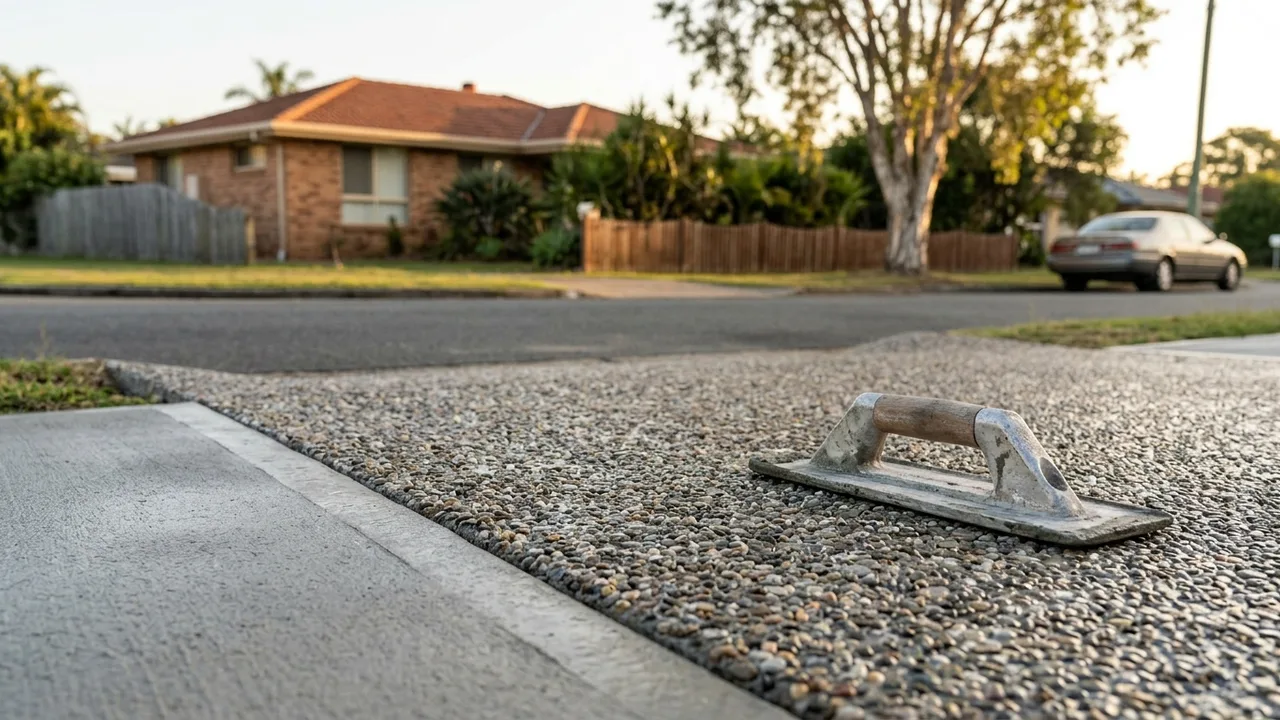
- Exposed aggregate. The concrete surface is treated while wet to reveal the stone underneath. Prices typically run $30 to $60 per square metre more than a plain broom finish, though this varies with stone choice and coverage area. Exposed aggregate is popular in Manly, Lota and Wynnum for its texture and the way it hides tyre marks and weathering.
- Coloured concrete. Oxide pigments are added to the mix. A mid-range addition to cost, and the colour does fade over time in Queensland's UV exposure. Worth considering whether you want to seal and maintain it periodically.
- Resurfacing over existing concrete. If your existing slab is structurally sound but looks worn or stained, resurfacing is considerably cheaper than a full replacement. The catch is that resurfacing relies on the base slab being in reasonable shape. If there's significant cracking or movement underneath, a new pour is the more honest answer.
Access, Crossover and Council Crossings
One cost that catches people off-guard is the kerb crossing or vehicle crossover. If you're creating a new driveway entry point, or widening an existing one, you'll typically need to deal with the footpath section and the kerb crossing. In Brisbane City Council areas, which covers the entire Bayside cluster, work in the road reserve requires council-approved materials and methods. Some crossover work needs to be carried out by or coordinated with a council-approved contractor.
This isn't a reason to avoid the work, but it is a reason to clarify early who handles the crossover portion and what approvals, if any, are needed. A concreter quoting only the private driveway portion while leaving the crossover unaddressed is giving you an incomplete picture of what the job actually costs.
Salt air, common in Manly, Wynnum and bayside Lota, also affects the council footpath material. Concrete mixes in these locations sometimes specify a higher-strength or more water-resistant blend for the crossing section.
Getting a Quote That's Actually Useful
The cheapest quote is not always bad value, and the most expensive quote is not always the best work. What matters is that a quote is specific enough to compare fairly.
A useful quote from any concreter should tell you:
- The square metreage being priced
- The concrete strength (MPa) and thickness (mm)
- The type of reinforcement
- What site preparation is included (excavation, fill, compaction)
- The finish specified
- Whether the crossover or footpath section is included or excluded
- The number and placement of control joints
If you receive a quote that's just a lump sum with a finish description and nothing else, ask for the line items. Any experienced concreter operating in Bayside will be comfortable giving you that detail.
As a final thought: concrete is a permanent material. A driveway poured properly on a well-prepared base, with appropriate reinforcement and control joints, should serve a Bayside Brisbane home reliably for 20 to 30 years with minimal maintenance. A driveway poured quickly on a poor base might look identical on the day it's finished, and look very different three wet seasons later. The detail in a quote is often the clearest signal of which kind you're looking at.
If you'd like to talk through what your specific driveway is likely to involve, including the ground conditions on your block and the best finish for your suburb, a local concreter who works regularly in the Bayside area can usually give you a ballpark over the phone before committing to a site visit.
Quick answers