Concreting guide
Why does new concrete crack and when should you actually be worried?
New concrete cracks. That's not a flaw — it's physics.
Concrete shrinks as it cures, and that shrinkage has to go somewhere. A hairline crack appearing in your new driveway or slab within the first few weeks is, in most cases, completely normal. The real question is whether the crack you're looking at is a sign of a healthy slab doing what concrete does, or a sign that something went wrong during the pour.
Here's how to tell the difference.
Why concrete cracks in the first place
Concrete is not a liquid that simply hardens. It undergoes a chemical reaction called hydration, where water bonds with cement particles and the whole mass gradually stiffens and tightens. As it does, the slab shrinks slightly, typically around 0.5 to 1 millimetre per metre of length. On a standard 6-metre driveway, that's 3 to 6 millimetres of total movement looking for somewhere to go.
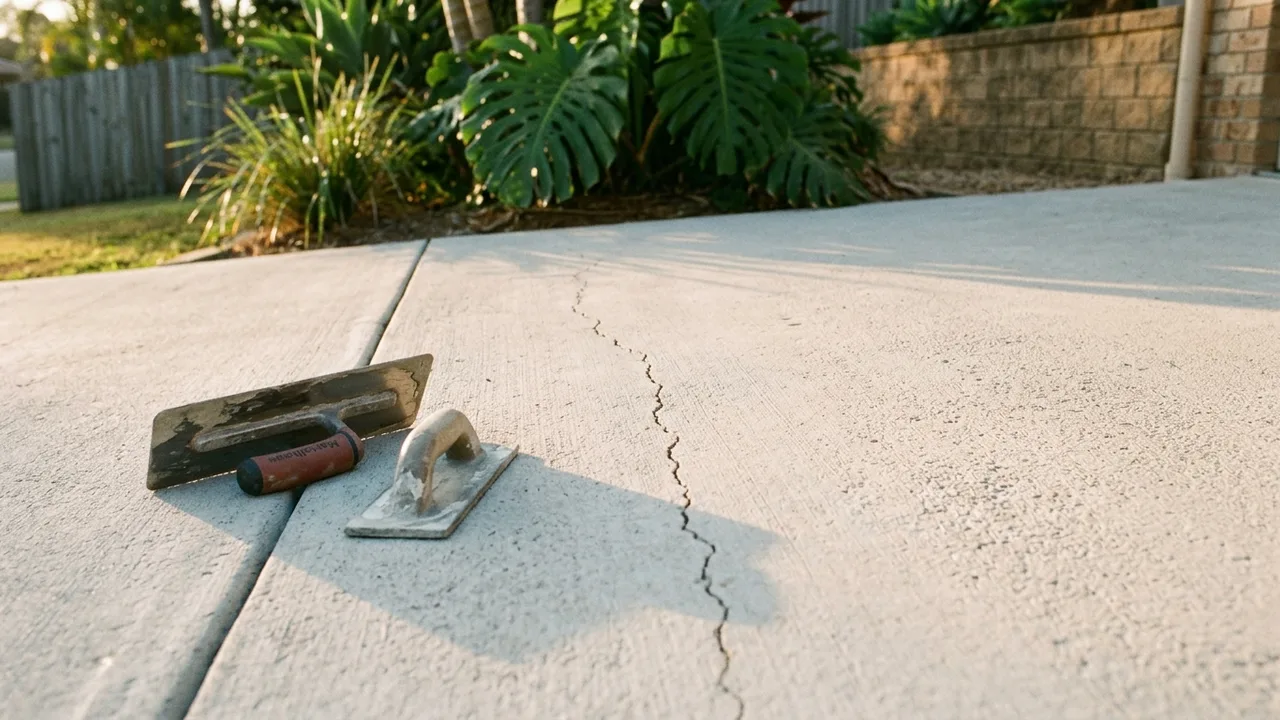
If the slab can't move freely, it cracks instead. The crack is actually relieving stress, which sounds counterintuitive but is by design. That's why concreters cut control joints into slabs: they create intentional weak points so any cracking happens in a straight, predictable line rather than a random spider web across your driveway.
Other common causes of early cracking include:
- Too much water in the mix. Adding water to concrete on-site makes it easier to work with, but weakens the finished product and increases shrinkage. A reputable concreter won't do this without adjusting the mix design.
- Drying too fast. Brisbane summers are rough on fresh concrete. If the surface dries faster than the interior, you get plastic shrinkage cracks, those fine surface lines that appear within hours of the pour. In Bayside suburbs like Wynnum and Manly, sea breezes can accelerate surface drying significantly on exposed sites.
- Not enough curing. Curing means keeping the concrete moist and protected for the first 3 to 7 days. Skipping this step, or letting it bake in direct afternoon sun without any cover, weakens the slab and increases cracking.
- Inadequate sub-base. If the ground underneath isn't compacted properly, soft spots will allow the slab to flex under load and crack. This is especially relevant in parts of Hemmant and Wynnum West where fill or reactive clay soils are more common.
Hairline cracks vs structural cracks: how to read what you're seeing
Not all cracks are equal. A hairline crack is generally defined as anything under about 0.3 millimetres wide. You can see it but you can't really catch a fingernail in it. These are almost always cosmetic and not worth losing sleep over, particularly on a plain broom-finished slab.
The cracks that warrant a closer look share a few common traits:
- Width over 3 millimetres. This is roughly the width of a pencil lead. At this size, water can get in, and in Bayside Brisbane's humid climate, that matters. Water infiltration leads to corrosion of any steel reinforcement inside the slab.
- Vertical displacement. Run your hand across the crack. If one side is higher than the other, the slab has moved in different directions. That's a structural problem, not a shrinkage problem.
- Cracks that grow. Photograph them and measure them. Hairline cracks that are stable over several months are not a concern. Cracks that keep widening or extending are telling you something is still moving underneath.
- Cracks running through control joints or reinforcement. If a crack bypasses the control joint entirely and runs diagonally across a slab, it suggests the joint wasn't placed in the right location or wasn't cut deep enough.
The Brisbane and Bayside factors that make cracking more likely
Brisbane's climate creates specific conditions that influence how concrete behaves, and the bayside area adds a few extra variables.
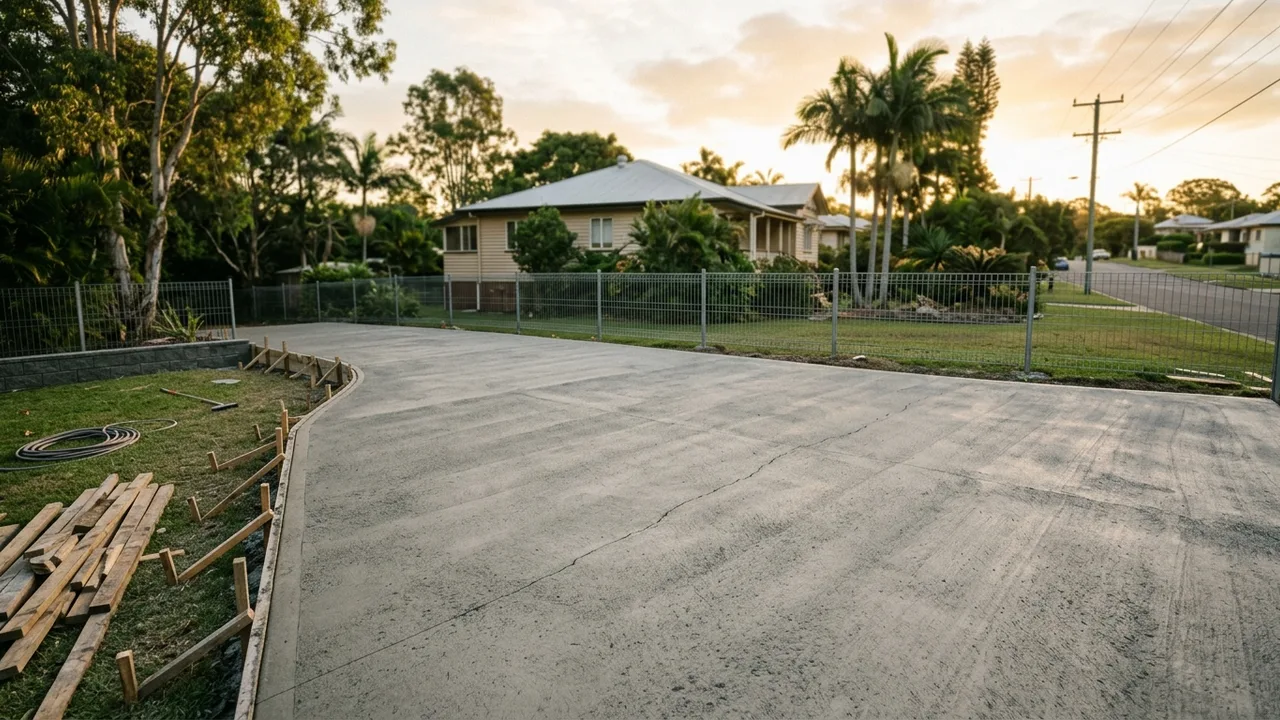
Heat and humidity swings. Concrete expands in heat and contracts in the cool. Brisbane's daily temperature range in summer can exceed 15 degrees Celsius. Over time, this thermal cycling works on any existing weakness in a slab. Concrete placed during a heatwave without adequate sun protection is more vulnerable.
Reactive clay soils. Parts of Hemmant, Lota and Wynnum West sit on reactive clay that swells when wet and shrinks when dry. A slab poured without a proper compacted base or without accounting for soil movement is fighting a losing battle. A good concreter will assess the soil type and recommend appropriate slab thickness, reinforcement and sometimes a sand or road base layer.
Salt air. Suburbs closer to the bay, particularly Manly and Wynnum, have a higher salt content in the air. Salt accelerates the corrosion of steel reinforcement inside a cracked slab. A surface crack that might be harmless in an inland suburb can become a bigger problem here if water and salt are getting in regularly. This is an argument for sealing concrete surfaces in bayside areas more diligently than you might elsewhere.
Tree roots. If you have a poinciana, fig or any large established tree near the slab, roots are a genuine cracking risk over time. This doesn't mean you shouldn't concrete near trees, but it does mean the design should account for it, sometimes with a root barrier or a thicker, more heavily reinforced edge.
When does a crack actually need fixing?
The practical answer is: fix it when it's letting water in, when it's a trip hazard, or when it's clearly getting worse.
For surface hairline cracks on a driveway or path, a flexible polyurethane sealant works reasonably well as a DIY repair and costs under $30 for a cartridge. It won't be invisible, but it will stop water ingress. This is a perfectly sensible approach for stable cracks on a plain slab.
For wider or displaced cracks, resurfacing is worth considering before the damage progresses. A concrete resurfacing product bonds to the existing slab and gives you a fresh surface without the cost of a full replacement, which is typically $80 to $120 per square metre for a new pour versus $25 to $60 per square metre for resurfacing. That's a meaningful cost difference on, say, a 40-square-metre driveway.
If the underlying cause is subsidence or soil movement, resurfacing will only mask the problem temporarily. In that situation, you need a concreter or a geotechnical professional to assess what's happening below the slab before spending anything on the surface.
What to do before you pour new concrete (the prevention side)
If you're planning a new driveway, shed slab or entertaining area and you want to minimise cracking from the start, here are the things worth insisting on:
- Ask your concreter what the planned control joint layout is, and how deep the cuts will be (typically one quarter of the slab depth).
- Confirm the sub-base preparation: minimum 100 millimetres of compacted road base for a driveway, more for a shed or garage slab that will carry vehicles.
- Ask about the concrete mix strength, measured in megapascals (MPa). A residential driveway typically calls for 25 MPa to 32 MPa. Lower than that and you're undershooting for Brisbane conditions.
- Plan the pour for cooler parts of the day in summer, ideally early morning, and ask about curing membrane or wet hessian if the slab will be exposed to afternoon sun.
- If you're in a reactive soil area, it's worth asking whether a thicker slab or additional mesh reinforcement is warranted.
The honest bottom line
Most cracks in new concrete are not a crisis. They're the material doing what concrete does, especially in Brisbane's heat. A hairline crack that's stable, dry and not a trip hazard is not worth stressing over.
The cracks that matter are wide (over 3 millimetres), displaced, growing, or located somewhere that puts water in contact with steel reinforcement, particularly near the bay where salt accelerates the damage.
If you're genuinely unsure whether what you're looking at is normal or not, the most useful thing you can do is photograph it, measure the width with a coin or ruler, check it again in six to eight weeks, and only then decide whether to act. A concreter who takes five minutes to look at a crack and gives you an honest assessment is worth their time. One who immediately quotes you for a full replacement without ruling out simpler options probably isn't.
If you'd like a local Bayside concreter to take a look, we can connect you with someone who services Hemmant, Wynnum, Manly and surrounding suburbs. No obligation to do anything beyond getting a straight answer.
Quick answers