Concreting guide
Why do concrete driveways and paths crack so often in Brisbane?
Concrete cracks. That is the short answer. It is not a sign of shoddy work by default, and it is not unique to Brisbane. But Brisbane's specific combination of climate, soil and tree cover does make cracking more common here than in cooler, drier cities. Understanding why helps you make smarter decisions before you pour, and more realistic ones after you notice that first hairline.
The clay soil problem underneath your slab
Most of the cracking you see on Brisbane driveways and paths starts below the surface, not in the concrete itself.
Brisbane sits on some of the most reactive clay soils in south-east Queensland. In the Bayside suburbs, from Hemmant through to Wynnum and Manly, that clay is often a dense, dark-grey variety that swells noticeably when wet and shrinks again as it dries out. Engineers call this "reactive" soil, and it is rated on a scale from Class A (stable, mostly sand) to Class H2 and E (highly reactive). Much of the Bayside area falls in the Class M to H1 range at a minimum.
When that clay moves, the concrete above it moves too. A slab that was sitting on firm ground in August can be bridging a small void by February after a dry spell. Concrete handles compression reasonably well but handles tension poorly. The moment part of it is unsupported, it bends slightly, and once the tensile stress exceeds the mix strength, a crack opens.
This is why two houses side by side can have very different outcomes. One block might have deeper sandy subsoil; the next might be sitting on clay all the way down. The contractor who poured both jobs may have done identical work.
Brisbane's wet-dry cycle does the actual damage
Reactive soil needs a trigger, and Brisbane's climate provides it year after year.
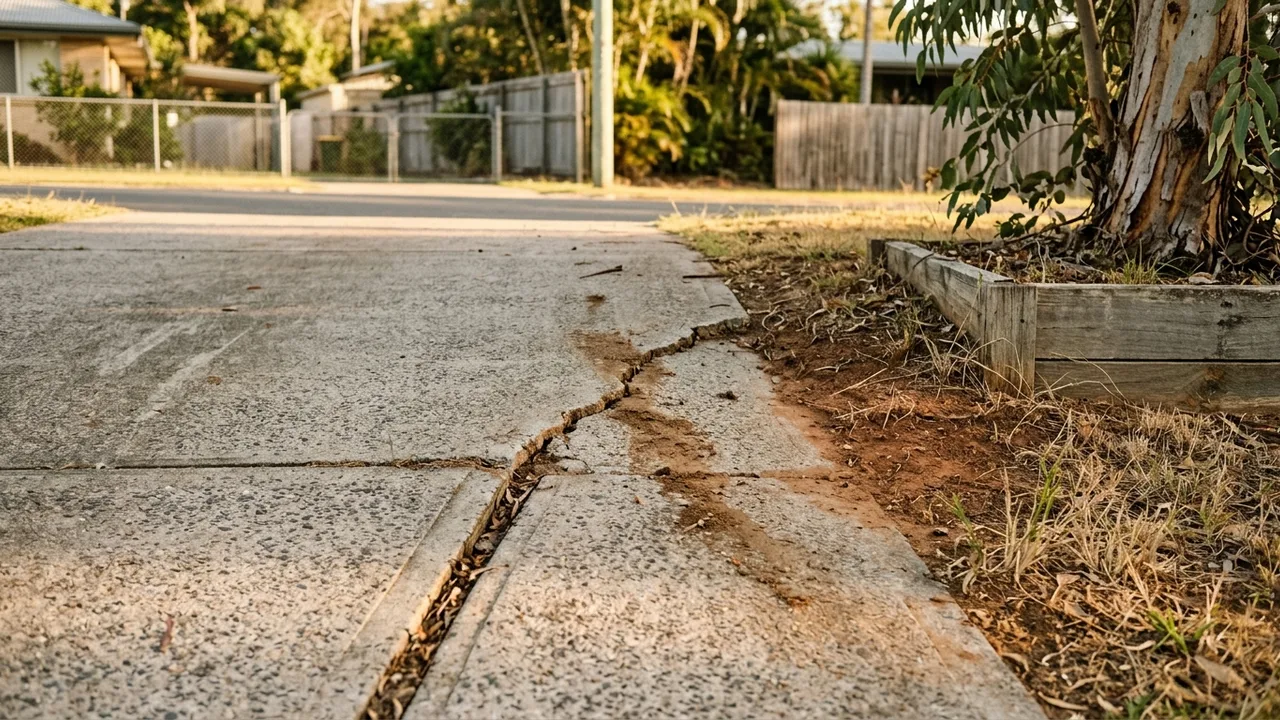
The wet season, typically November through March, saturates the ground. Clay swells. The dry season, from around June to September, bakes it back down. In some years you get both extremes in the same month. The clay lifts, the clay drops, the slab goes along for the ride, and each cycle adds a small amount of fatigue stress to the concrete.
Hemmant and the surrounding Bayside suburbs sit close to Moreton Bay, which adds humidity to the mix without softening the dry-season shrinkage problem. Salt air is a secondary factor worth noting, particularly for exposed aggregate and coloured surfaces in Wynnum, Manly and Lota, where coastal exposure can gradually attack concrete that was not sealed properly. It does not cause cracking directly, but it degrades the surface and can widen existing hairlines over time.
Tree roots are a related issue across the whole cluster. Many Bayside streets have mature Moreton Bay figs, poinciana and jacaranda. Root systems from those trees can extend ten metres or more from the trunk, and they follow moisture gradients, often straight under a driveway or path. As a root thickens over years, it exerts upward pressure on the slab. The crack that results is usually one of the more dramatic ones: a raised edge that becomes a trip hazard.
What the concrete mix and pour quality actually control
Soil and climate create the loading. Mix design and pour technique determine whether the slab survives it or not.
Water-to-cement ratio is the single most important variable the concretor controls. A wetter mix is easier to work with on a hot Brisbane day, but excess water evaporates during curing and leaves a more porous, weaker matrix. In practical terms, the difference between a correctly specified mix and one that had water added on-site to slow the set can be a significant reduction in final compressive strength.
Curing time and method matters more here than in southern states because Brisbane summers are hot. Concrete that dries too fast on the surface while the interior is still curing develops surface shrinkage cracks, sometimes called "plastic shrinkage" cracks, within the first 24 hours. They are usually shallow and narrow, but they are entry points for water and root growth later on.
Control joints (the deliberate scored lines cut into a slab) are the industry's honest admission that concrete will crack, so let us tell it where to crack. A correctly spaced and correctly cut control joint creates a weak plane that concentrates movement in one predictable location rather than wherever the slab feels like. In a standard residential driveway, joints are typically placed every 1.2 to 1.5 times the slab thickness in metres, though practice varies. When joints are spaced too far apart, or cut too shallow, they fail to do their job and random cracking fills the gap.
Reinforcement does not prevent cracking but it holds the slab together after a crack forms, which limits widening and keeps the surface usable. Steel mesh (F72 or F82 for typical residential work) and cut-and-bent steel bar (reo bar) are the common options. Neither is always better; the choice depends on slab thickness, expected load and budget. Mesh is cheaper and faster to lay; reo bar gives more control over placement and is often used for thicker slabs like garage floors or where a vehicle heavier than a passenger car will park.
Does thickness make a real difference?
Yes, within reason. A residential driveway poured at 75mm is at the minimum end and relies heavily on stable subgrade and good curing. At 100mm you have a meaningful increase in bending resistance. At 125mm or more you are into territory that handles the odd delivery truck or skip bin without much drama.
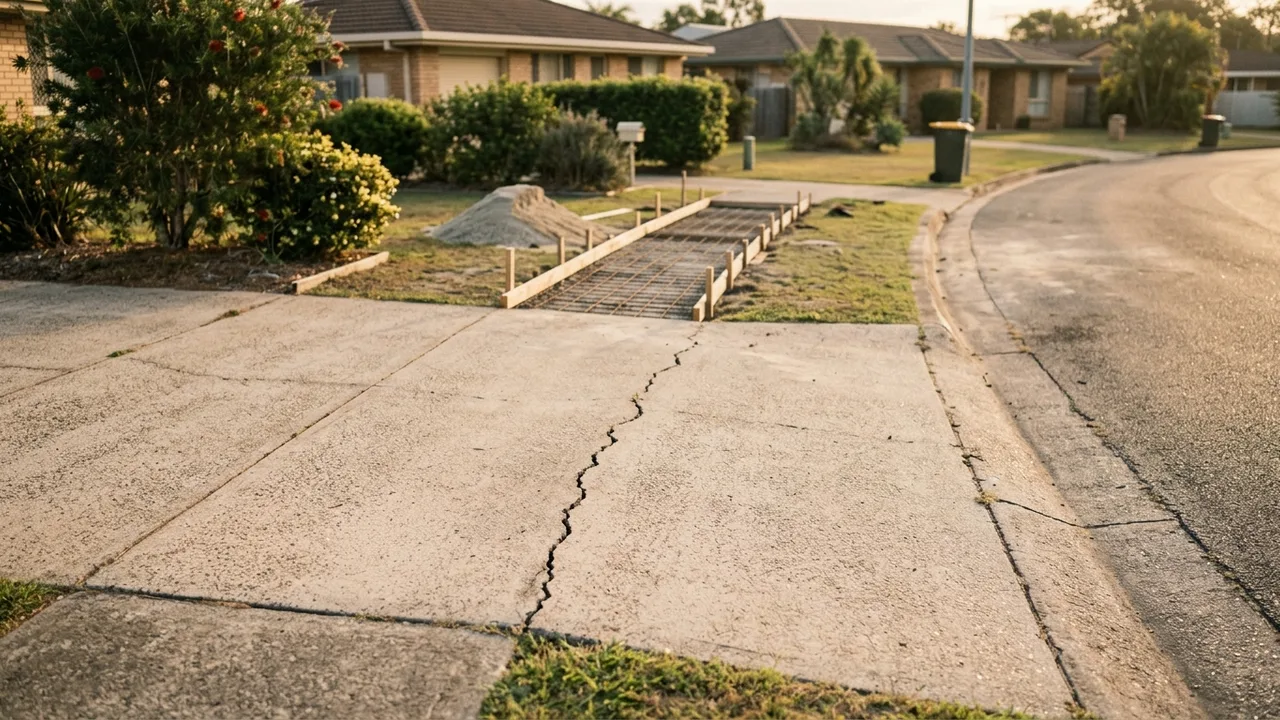
The trade-off is cost. Going from 75mm to 100mm on a typical double driveway in Hemmant or Wynnum West adds roughly $300 to $600 to the concrete volume alone, before labour. For most households that is a worthwhile spend given the reactive soil conditions. For a lightly used garden path, 75mm is usually fine.
Repair, resurface or replace: how to read a cracked slab
Not every crack means the slab needs to come up. Here is a rough guide.
Hairline cracks (less than about 1mm wide, no vertical displacement) are mostly cosmetic. A concrete sealer or flexible crack filler extends the life of the slab by keeping water and roots out. This is a job most confident homeowners can do themselves with products from a hardware store. Cost is low; benefit is real.
Cracks with vertical displacement (one side of the crack is higher than the other) indicate differential movement in the subgrade. Filling the crack surface without addressing what caused it is a temporary fix. In Bayside suburbs where tree roots are often the culprit, the root may need to be removed or redirected before any surface repair holds long-term.
Widespread cracking or a slab that has lifted significantly is usually a replacement job. Grinding down raised edges and applying a resurfacing compound can buy a few more years, but if the subgrade is still moving the cycle repeats. Replacement at that stage, with better subgrade preparation and correctly spaced joints, is typically more cost-effective over a ten-year horizon than repeated patching.
A concrete repairs specialist can tell you which category your situation falls into after a visual inspection. The honest answer from most experienced concretors is that minor cracking is almost always repairable; significant subgrade movement is the problem that needs solving first.
A practical closing thought
Brisbane's climate and soil are not going to change. Some cracking on concrete surfaces is realistic to expect over a ten to fifteen year period, even on a well-poured slab. What you can control is the quality of the subgrade preparation before the pour, the specification of the mix, how joints are placed, and how quickly you seal or address cracks when they first appear.
If you are planning a new driveway, path or patio in the Hemmant area or anywhere across the Bayside cluster, ask the concretor specifically how they handle subgrade compaction, what mix strength they are specifying, and where and how deep they will cut control joints. A contractor who gives you clear answers on those three points is one who has thought about longevity, not just the finish.
If you have an existing slab showing cracks and you are not sure what category they fall into, a quick inspection is usually free and gives you the information to decide whether a $150 tube of filler or a $3,000 replacement section is the smarter move.
Quick answers